Ch. 2 Chemistry Comes Alive
Marieb - Human Anatomy & Physiology 11th Edition
Marieb, Hoehn11th EditionHuman Anatomy & PhysiologyISBN: 9780136874034Not the one you use?Change textbook
Chapter 2, Problem 25

Mrs. Roberts, in a diabetic coma, has just been admitted to Noble Hospital. Her blood pH indicates that she is in severe acidosis (low blood pH), and measures are quickly instituted to bring her blood pH back within normal limits.
a. Define pH and note the normal pH of blood.
b. Why is severe acidosis a problem?

Verified step by step guidance
1
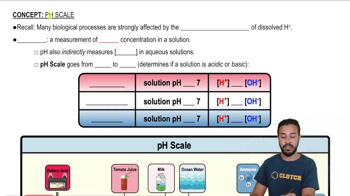
Define pH as a measure of hydrogen ion concentration in a solution, expressed mathematically as \(\mathrm{pH} = -\log_{10}[\mathrm{H}^+]\), where \([\mathrm{H}^+]\) is the molar concentration of hydrogen ions.
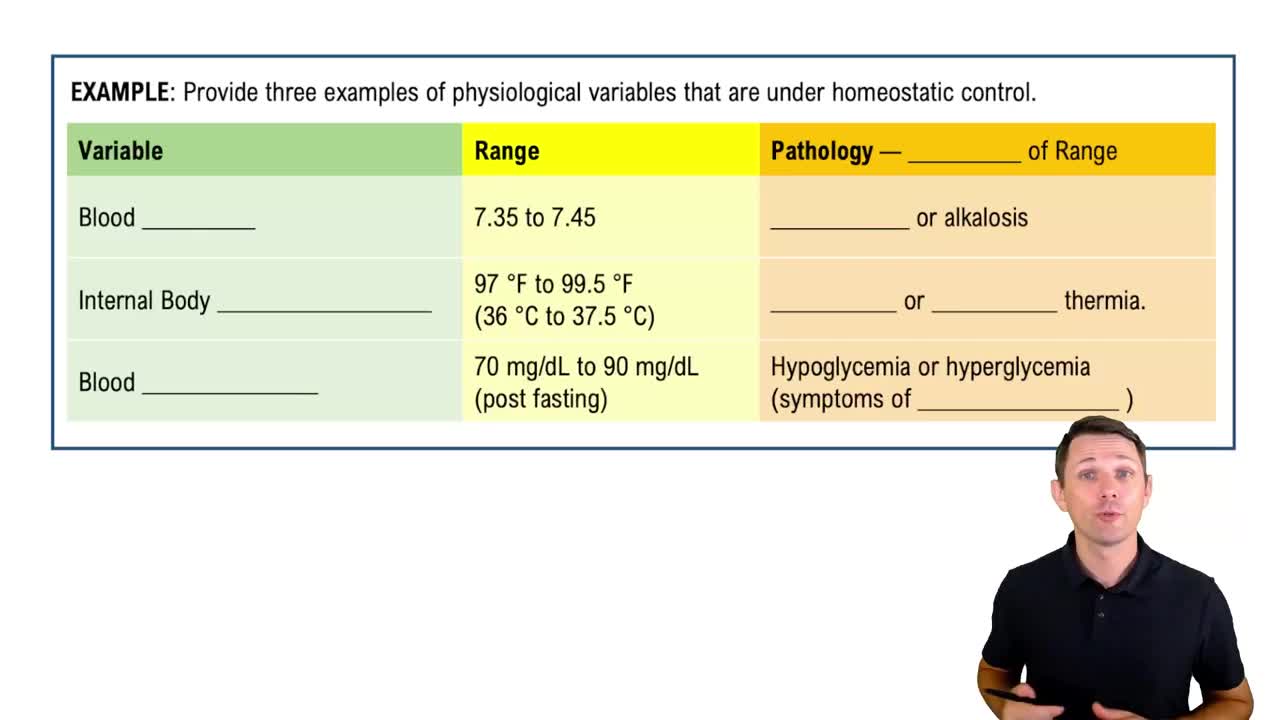
State that the normal pH of human blood is tightly regulated and typically ranges from 7.35 to 7.45, which is slightly alkaline.
Explain that severe acidosis means the blood pH falls below the normal range, indicating an excess of hydrogen ions and increased acidity in the blood.
Discuss why severe acidosis is a problem: it disrupts the normal function of enzymes and proteins, impairs cellular metabolism, and can affect the nervous and cardiovascular systems, potentially leading to life-threatening complications.
Highlight that restoring blood pH to normal is critical to maintain homeostasis and proper physiological function, which is why immediate medical intervention is necessary in cases like Mrs. Roberts's diabetic coma.

Verified video answer for a similar problem:

This video solution was recommended by our tutors as helpful for the problem above.
Video duration:
3m
Was this helpful?

Key Concepts

Here are the essential concepts you must grasp in order to answer the question correctly.

pH and Its Definition

pH is a measure of the hydrogen ion concentration in a solution, indicating its acidity or alkalinity. It is calculated as the negative logarithm of the hydrogen ion concentration (pH = -log[H+]). A lower pH means higher acidity, while a higher pH indicates alkalinity.
Recommended video:
07:58
pH Scale

Normal Blood pH Range

The normal pH of human blood ranges from 7.35 to 7.45, which is slightly alkaline. Maintaining this narrow range is crucial for proper cellular function and metabolic processes. Deviations can disrupt enzyme activity and biochemical reactions.
Recommended video:
07:58
pH Scale

Consequences of Severe Acidosis

Severe acidosis, characterized by a blood pH below 7.35, impairs cellular function and enzyme activity, leading to metabolic disturbances. It can cause symptoms like confusion, lethargy, and can depress cardiac function, potentially resulting in life-threatening complications.
Recommended video:
Guided course
03:46
Homeostasis Example 1