Ch. 23 The Digestive System
Marieb - Human Anatomy & Physiology 11th Edition
Marieb, Hoehn11th EditionHuman Anatomy & PhysiologyISBN: 9780136874034Not the one you use?Change textbook
Chapter 23, Problem 19

Lara was on a diet but she could not eat less and kept claiming her stomach had a mind of its own. She was joking, but indeed, there is a 'gut brain' called the enteric nervous system. Is it part of the parasympathetic and sympathetic nervous system? Explain.

Verified step by step guidance
1
Step 1: Understand the enteric nervous system (ENS) as a complex network of neurons located in the walls of the gastrointestinal tract, often called the 'gut brain' because it can operate independently of the central nervous system.
Step 2: Recognize that the ENS is considered a part of the autonomic nervous system but is distinct in that it can function autonomously to regulate digestive processes such as motility, secretion, and blood flow.
Step 3: Know that the ENS interacts with both the parasympathetic and sympathetic nervous systems, receiving input from them to modulate its activity, but it is not simply a subset of either system.
Step 4: Explain that the parasympathetic nervous system generally stimulates digestive activities (e.g., increasing motility and secretion), while the sympathetic nervous system tends to inhibit these functions, and the ENS integrates these signals to maintain gut function.
Step 5: Conclude that the ENS is a unique, semi-autonomous system that works alongside but is not directly part of the parasympathetic or sympathetic nervous systems, highlighting its role as an independent regulator within the autonomic nervous system.

Verified video answer for a similar problem:

This video solution was recommended by our tutors as helpful for the problem above.
Video duration:
3m
Was this helpful?

Key Concepts

Here are the essential concepts you must grasp in order to answer the question correctly.

Enteric Nervous System (ENS)

The enteric nervous system is a complex network of neurons located in the walls of the gastrointestinal tract. It controls digestion independently but also communicates with the central nervous system. Often called the 'second brain,' it regulates gut motility, secretion, and blood flow.
Recommended video:
3:33
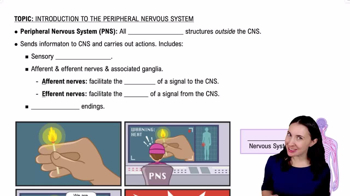
Peripheral Nervous System

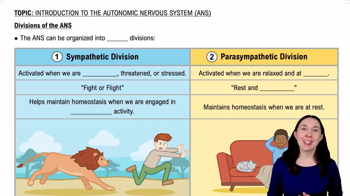
Autonomic Nervous System (ANS) Divisions

The autonomic nervous system consists of two main branches: the sympathetic and parasympathetic nervous systems. The sympathetic system prepares the body for 'fight or flight' responses, while the parasympathetic system promotes 'rest and digest' activities, both influencing various organs including the gut.
Recommended video:
3:10
Divisions of the ANS

Relationship Between ENS and ANS

Although the enteric nervous system can operate independently, it is functionally connected to both the sympathetic and parasympathetic systems. The ANS modulates ENS activity by either stimulating or inhibiting gut functions, integrating digestive processes with overall bodily states.
Recommended video:
4:14
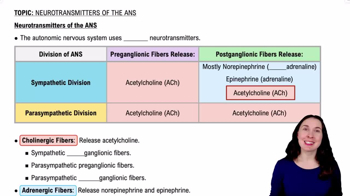
Neurotransmitters of the ANS