Ch. 27 The Reproductive System
Marieb - Human Anatomy & Physiology 11th Edition
Marieb, Hoehn11th EditionHuman Anatomy & PhysiologyISBN: 9780136874034Not the one you use?Change textbook
Chapter 27, Problem 26

Erin had both her left ovary and her right uterine tube removed surgically at age 17 because of a cyst and a tumor in these organs. Now, at age 32, she remains healthy and is expecting her second child. How could Erin conceive a child with just one ovary and one uterine tube, widely separated on opposite sides of the pelvis like this?

Verified step by step guidance
1
Understand the anatomy and physiology of the female reproductive system: The ovaries produce eggs (ova), and the uterine tubes (fallopian tubes) transport the eggs to the uterus. Fertilization typically occurs in the uterine tube.
Recognize that the remaining ovary can still produce eggs: Even with one ovary, Erin's body can continue to ovulate, releasing eggs into the pelvic cavity during her menstrual cycle.
Learn about the role of the fimbriae of the uterine tube: The fimbriae are finger-like projections at the end of the uterine tube that can sweep up an egg released from the ovary, even if the ovary is on the opposite side of the pelvis. This process is facilitated by the egg's movement within the pelvic cavity.
Understand the adaptability of the reproductive system: The egg released from the ovary can travel across the pelvic cavity and be captured by the uterine tube on the opposite side. This is possible due to the close proximity of the reproductive organs within the pelvis and the fluid environment that allows the egg to move.
Recognize the importance of a healthy uterus and hormonal function: Erin's uterus and hormonal system must be functioning properly to support implantation and pregnancy after fertilization occurs in the uterine tube.

Key Concepts

Here are the essential concepts you must grasp in order to answer the question correctly.

Ovarian Function

The ovaries are responsible for producing eggs and hormones like estrogen and progesterone. A woman can conceive with just one ovary, as each ovary can release eggs independently. The remaining ovary can compensate for the loss of the other, maintaining hormonal balance and ovulation, which is essential for conception.
Recommended video:
06:04
Functional Groups

Uterine Tube Function

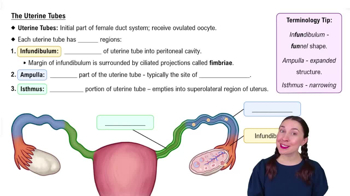
The uterine tubes, or fallopian tubes, are crucial for fertilization, as they transport the egg from the ovary to the uterus. Even with one tube, if it is functional, it can capture the egg released by the ovary and facilitate fertilization by sperm. This means that having one tube does not preclude the possibility of conception.
Recommended video:
3:58
The Uterine Tubes

Compensatory Mechanisms in Reproductive Health

The human body has various compensatory mechanisms that allow it to adapt to changes or losses. In reproductive health, the remaining ovary and uterine tube can work together effectively, allowing for normal reproductive function. This adaptability can enable women to conceive even after surgical removal of reproductive organs.
Recommended video:
2:08
What is the Reproductive System?