Ch. 27 The Reproductive System
Marieb - Human Anatomy & Physiology 11th Edition
Marieb, Hoehn11th EditionHuman Anatomy & PhysiologyISBN: 9780136874034Not the one you use?Change textbook
Chapter 27, Problem 10

Which of the following does not add a secretion that makes a major contribution to semen?
a. Prostate
b. Bulbo-urethral glands
c. Testes
d. Ductus deferens

Verified step by step guidance
1
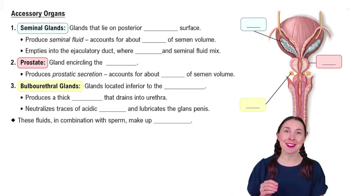
Step 1: Understand the components of the male reproductive system and their roles in semen production. Semen is composed of sperm cells and secretions from accessory glands, including the prostate, seminal vesicles, and bulbo-urethral glands.
Step 2: Review the function of the prostate gland. The prostate contributes a significant portion of the seminal fluid, including enzymes and nutrients that support sperm motility and survival.
Step 3: Examine the role of the bulbo-urethral glands. These glands secrete a small amount of mucus-like fluid that helps lubricate the urethra but does not make a major contribution to the volume of semen.
Step 4: Analyze the function of the testes. The testes produce sperm cells, which are the primary reproductive cells in semen, but they do not secrete fluid that contributes to the seminal fluid itself.
Step 5: Consider the ductus deferens. This structure is responsible for transporting sperm from the epididymis to the urethra but does not add any secretions to semen.

Verified video answer for a similar problem:

This video solution was recommended by our tutors as helpful for the problem above.
Video duration:
2m
Was this helpful?

Key Concepts

Here are the essential concepts you must grasp in order to answer the question correctly.

Semen Composition

Semen is a fluid that contains sperm and various secretions from male reproductive glands. The primary components include sperm from the testes and fluids from the prostate, seminal vesicles, and bulbo-urethral glands, which provide nutrients and a suitable environment for sperm motility.
Recommended video:
7:49
Composition of Blood

Role of the Prostate

The prostate gland contributes a significant portion of the seminal fluid, producing a milky secretion that contains enzymes, citric acid, and prostate-specific antigen (PSA). This fluid helps to nourish sperm and enhance their motility, playing a crucial role in male fertility.
Recommended video:
3:21
Accessory Organs

Function of the Ductus Deferens

The ductus deferens, also known as the vas deferens, is a muscular tube that transports sperm from the epididymis to the ejaculatory duct. While it plays a vital role in sperm delivery, it does not produce any secretions that contribute to the composition of semen.
Recommended video:
06:04
Functional Groups