Understand that gastrulation is a crucial early developmental process in embryology, where the single-layered blastula reorganizes into a multilayered structure called the gastrula.
Recognize that the main function of gastrulation is to form the three primary germ layers: ectoderm, mesoderm, and endoderm, which will later differentiate into all tissues and organs of the body.
Note that during gastrulation, cells undergo extensive movements such as invagination, involution, and epiboly to position themselves correctly within the embryo.
Understand that the formation of these germ layers establishes the body plan and lays the foundation for organogenesis, the development of organs.
Summarize that the function of gastrulation is to transform the simple blastula into a complex structure with distinct layers, each destined to form specific tissues and organs in the developing organism.
Key Concepts
Here are the essential concepts you must grasp in order to answer the question correctly.
Gastrulation
Gastrulation is a crucial early embryonic process where a single-layered blastula reorganizes into a multilayered structure called the gastrula. This process establishes the three primary germ layers: ectoderm, mesoderm, and endoderm.
The primary germ layers formed during gastrulation—ectoderm, mesoderm, and endoderm—are the foundational tissues that give rise to all organs and systems in the body. Each layer differentiates into specific cell types and structures.
Gastrulation initiates morphogenetic movements that shape the embryo’s body plan, setting the stage for organ formation and body axis establishment. It is essential for proper spatial organization during development.


 Verified step by step guidance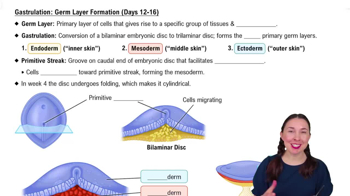
 3:54
3:54