Ch. 9 Muscles and Muscle Tissue
Marieb - Human Anatomy & Physiology 11th Edition
Marieb, Hoehn11th EditionHuman Anatomy & PhysiologyISBN: 9780136874034Not the one you use?Change textbook
Chapter 9, Problem 23

a. Describe the structure of a sarcomere and indicate the relationship of the sarcomere to myofilaments.
b. Explain the sliding filament model of contraction using appropriately labeled diagrams of a relaxed and a contracted sarcomere.

Verified step by step guidance
1
Step 1: Describe the sarcomere as the basic functional unit of a muscle fiber, defined as the segment between two Z discs (or Z lines). Explain that it is composed of organized myofilaments: thick filaments made primarily of myosin and thin filaments made primarily of actin.
Step 2: Explain the arrangement of these myofilaments within the sarcomere: thin filaments attach to the Z discs and extend toward the center, while thick filaments are located in the center of the sarcomere overlapping with thin filaments. Mention the presence of the A band (length of thick filaments), I band (region with only thin filaments), H zone (region with only thick filaments), and M line (center of thick filaments).
Step 3: Introduce the sliding filament model by describing how muscle contraction occurs when thin filaments slide past thick filaments, shortening the sarcomere without changing the length of the filaments themselves.
Step 4: For the relaxed sarcomere, describe the wider I bands and H zone, indicating less overlap between thick and thin filaments. For the contracted sarcomere, describe how the I bands and H zone narrow or disappear due to increased overlap, while the A band remains constant in length.
Step 5: Suggest drawing or visualizing two diagrams side by side: one of a relaxed sarcomere showing clear bands and zones, and one of a contracted sarcomere showing shortened distance between Z discs and increased overlap of filaments, labeling the Z discs, A band, I band, H zone, thick and thin filaments to illustrate the sliding filament mechanism.

Verified video answer for a similar problem:

This video solution was recommended by our tutors as helpful for the problem above.
Video duration:
3m
Was this helpful?

Key Concepts

Here are the essential concepts you must grasp in order to answer the question correctly.

Structure of a Sarcomere

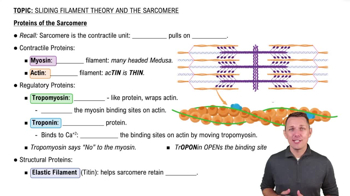
A sarcomere is the basic contractile unit of striated muscle, defined by Z-discs at each end. It contains organized myofilaments: thick filaments made of myosin and thin filaments made of actin. The arrangement of these filaments creates distinct bands (A, I, H) visible under a microscope, essential for muscle contraction.
Recommended video:
Guided course
7:18
Proteins of the Sarcomere

Myofilaments and Their Role in the Sarcomere

Myofilaments are protein filaments within the sarcomere responsible for contraction. Thick filaments (myosin) have heads that bind to thin filaments (actin) to generate force. The interaction and overlap of these filaments determine the sarcomere’s length and contraction state.
Recommended video:
Guided course
7:18
Proteins of the Sarcomere

Sliding Filament Model of Muscle Contraction

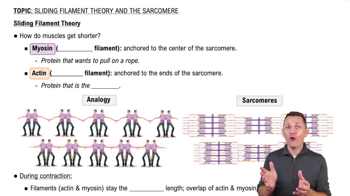
The sliding filament model explains muscle contraction as the sliding of thin filaments past thick filaments, shortening the sarcomere without changing filament length. During contraction, actin and myosin filaments slide closer, reducing the I-band and H-zone, which shortens the muscle fiber and generates tension.
Recommended video:
Guided course
6:26
Sliding Filament Theory