Ch. 10 Blood
Marieb - Essentials of Human Anatomy & Physiology 13th Edition
Marieb13th EditionEssentials of Human Anatomy & PhysiologyISBN: 9780135624340Not the one you use?Change textbook
Chapter 10, Problem 14

Name as many different categories of substances carried in plasma as you can.

Verified step by step guidance
1
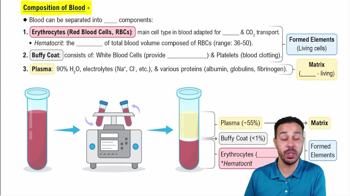
Understand that plasma is the liquid component of blood, making up about 55% of its total volume. It serves as a transport medium for various substances throughout the body.
Identify the major categories of substances carried in plasma, which include proteins such as albumin, globulins, and fibrinogen. These proteins play roles in maintaining osmotic pressure, immune responses, and blood clotting.
Recognize that plasma also carries nutrients like glucose, amino acids, fatty acids, and vitamins, which are essential for cellular metabolism and energy production.
Note that plasma transports waste products such as urea, creatinine, and bilirubin, which are destined for excretion by the kidneys or liver.
Include other categories such as electrolytes (e.g., sodium, potassium, calcium, chloride), hormones, gases (e.g., oxygen and carbon dioxide), and water, which are vital for maintaining homeostasis and physiological functions.

Verified video answer for a similar problem:

This video solution was recommended by our tutors as helpful for the problem above.
Video duration:
2m
Was this helpful?

Key Concepts

Here are the essential concepts you must grasp in order to answer the question correctly.

Plasma Composition

Plasma is the liquid component of blood, making up about 55% of its total volume. It consists primarily of water, electrolytes, proteins, hormones, nutrients, and waste products. Understanding plasma composition is essential for identifying the various substances it carries, which play critical roles in bodily functions.
Recommended video:
7:49
Composition of Blood

Proteins in Plasma

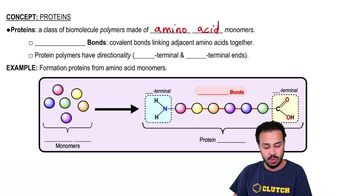
Plasma proteins, such as albumin, globulins, and fibrinogen, are vital for maintaining osmotic pressure, immune responses, and blood clotting. Each type of protein has specific functions, and their concentrations can indicate various health conditions. Recognizing these proteins helps in understanding the overall functionality of plasma.
Recommended video:
02:50
Proteins

Electrolytes and Nutrients

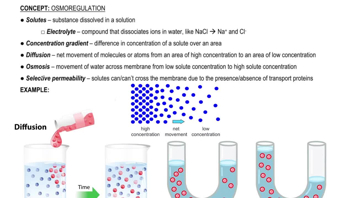
Electrolytes, including sodium, potassium, calcium, and bicarbonate, are essential for maintaining fluid balance, nerve function, and muscle contraction. Additionally, plasma carries nutrients like glucose, amino acids, and lipids, which are crucial for energy production and cellular function. Identifying these substances is key to understanding plasma's role in homeostasis.
Recommended video:
07:59
Osmosis and Osmolarity