Ch. 3 Cells and Tissues
Marieb - Essentials of Human Anatomy & Physiology 13th Edition
Marieb13th EditionEssentials of Human Anatomy & PhysiologyISBN: 9780135624340Not the one you use?Change textbook
Chapter 3, Problem 6

For diffusion to occur, there must be:
a. A selectively permeable membrane
b. Equal amounts of solute
c. A concentration difference
d. Some sort of carrier system
e. All of the above

Verified step by step guidance
1
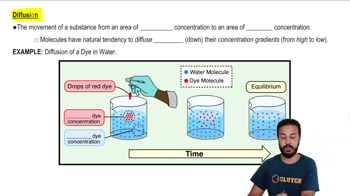
Understand the concept of diffusion: Diffusion is the movement of molecules from an area of higher concentration to an area of lower concentration, driven by the concentration gradient. It does not require energy and occurs naturally.
Evaluate option (a): A selectively permeable membrane is not required for diffusion to occur. Diffusion can happen in open systems without membranes, such as gases mixing in the air.
Evaluate option (b): Equal amounts of solute do not facilitate diffusion. Diffusion occurs due to a concentration difference, so this option is incorrect.
Evaluate option (c): A concentration difference is essential for diffusion to occur. Molecules move from areas of higher concentration to lower concentration until equilibrium is reached.
Evaluate option (d): A carrier system is not necessary for diffusion. Carrier systems are typically involved in facilitated diffusion or active transport, which are different processes.

Verified video answer for a similar problem:

This video solution was recommended by our tutors as helpful for the problem above.
Video duration:
5m
Was this helpful?

Key Concepts

Here are the essential concepts you must grasp in order to answer the question correctly.

Diffusion

Diffusion is the process by which molecules move from an area of higher concentration to an area of lower concentration. This passive transport mechanism occurs until equilibrium is reached, meaning the concentration of molecules is equal throughout the space. It is a fundamental concept in biology, particularly in understanding how substances move across cell membranes.
Recommended video:
02:44
Diffusion

Selectively Permeable Membrane

A selectively permeable membrane is a barrier that allows certain substances to pass while restricting others. This property is crucial for maintaining homeostasis in cells, as it regulates the entry and exit of ions, nutrients, and waste products. In the context of diffusion, such membranes facilitate the movement of molecules based on concentration gradients.
Recommended video:
6:43
Clonal Selection

Concentration Gradient

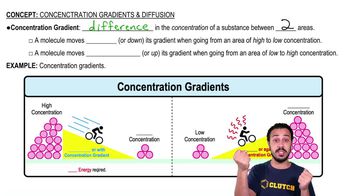
A concentration gradient refers to the difference in the concentration of a substance between two areas. It is the driving force behind diffusion, as molecules naturally move from regions of higher concentration to regions of lower concentration. Understanding concentration gradients is essential for grasping how substances distribute themselves in biological systems.
Recommended video:
04:51
Concentration Gradients and Diffusion