Ch. 3 Cells and Tissues
Marieb - Essentials of Human Anatomy & Physiology 13th Edition
Marieb13th EditionEssentials of Human Anatomy & PhysiologyISBN: 9780135624340Not the one you use?Change textbook
Chapter 3, Problem 7

In which of the following tissue types might you expect to find goblet cells?
a. Simple cuboidal
b. Simple columnar
c. Simple squamous
d. Stratified squamous
e. Transitional

Verified step by step guidance
1
Understand the function of goblet cells: Goblet cells are specialized epithelial cells responsible for secreting mucus, which helps lubricate and protect surfaces. They are typically found in tissues that require mucus secretion for protection or movement.
Review the characteristics of each tissue type: Simple cuboidal epithelium is involved in secretion and absorption but does not typically contain goblet cells. Simple columnar epithelium often contains goblet cells, especially in areas like the digestive tract where mucus secretion is needed. Simple squamous epithelium is thin and primarily involved in diffusion and filtration, not mucus secretion. Stratified squamous epithelium is designed for protection and does not typically contain goblet cells. Transitional epithelium is specialized for stretching and does not usually have goblet cells.
Match the tissue types with the presence of goblet cells: Goblet cells are most commonly found in simple columnar epithelium, as this tissue type is associated with mucus secretion in areas like the respiratory and digestive tracts.
Eliminate tissue types that do not align with goblet cell function: Simple squamous, stratified squamous, and transitional epithelium do not support mucus secretion and are unlikely to contain goblet cells. Simple cuboidal epithelium may occasionally have goblet cells, but it is not a primary location for them.
Conclude that the tissue type most likely to contain goblet cells is simple columnar epithelium, with a possibility of simple cuboidal epithelium in certain cases. This aligns with the functional role of goblet cells in mucus secretion.

Verified video answer for a similar problem:

This video solution was recommended by our tutors as helpful for the problem above.
Video duration:
3m
Was this helpful?

Key Concepts

Here are the essential concepts you must grasp in order to answer the question correctly.

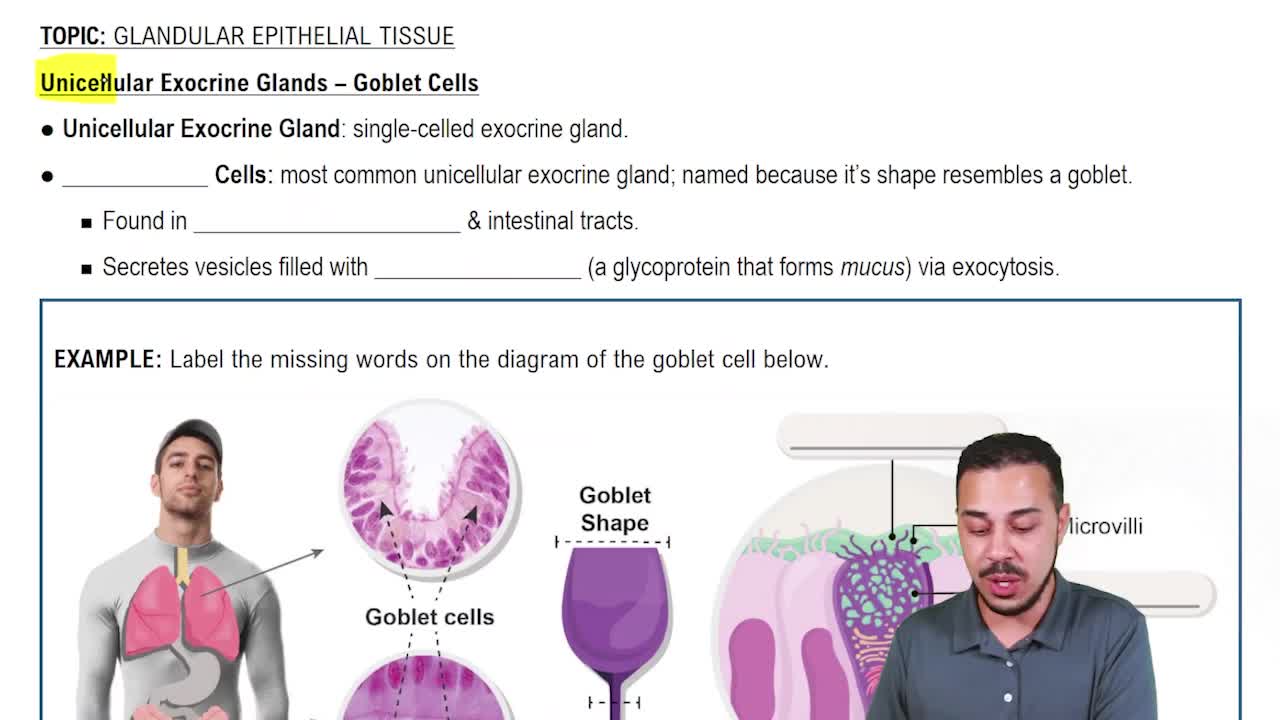
Goblet Cells

Goblet cells are specialized epithelial cells that secrete mucus. They are primarily found in the respiratory and gastrointestinal tracts, where they play a crucial role in lubrication and protection of the mucosal surfaces. Their presence is indicative of certain types of epithelial tissue, particularly those involved in secretion.
Recommended video:
Guided course
04:39
Unicellular Exocrine Glands - Goblet Cells

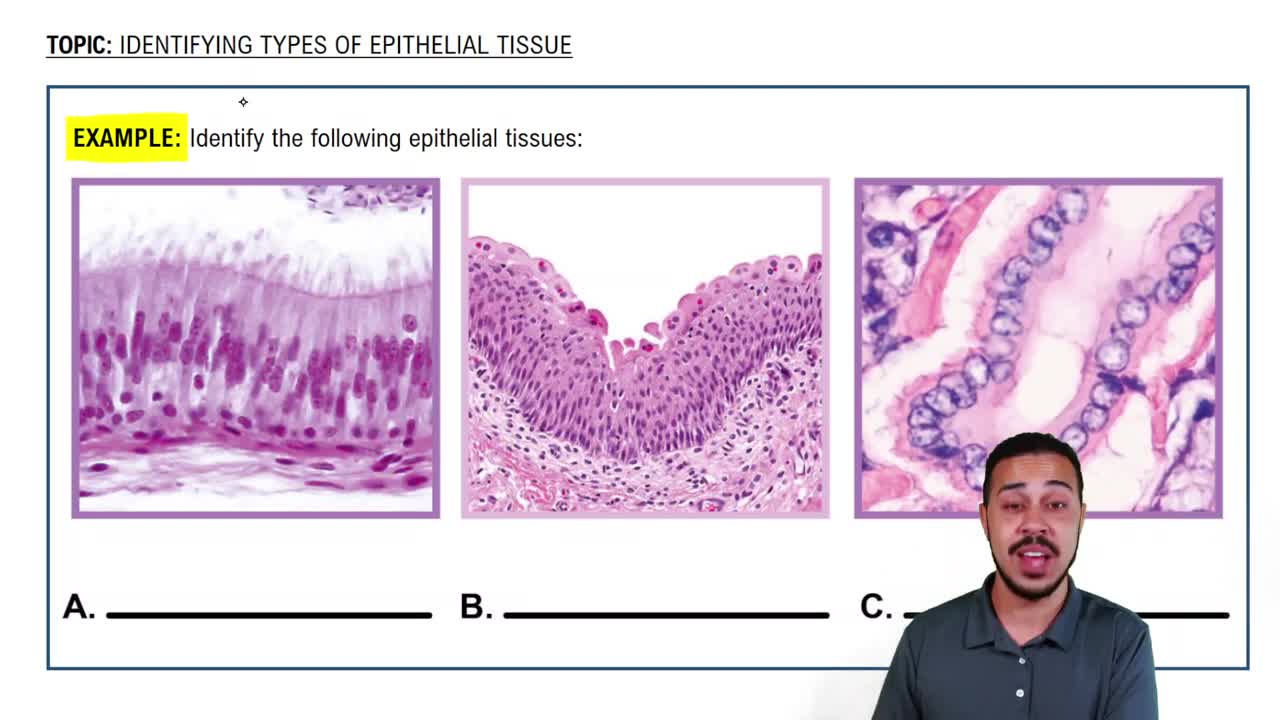
Epithelial Tissue Types

Epithelial tissue is classified into various types based on cell shape and arrangement. The main types include simple (single layer) and stratified (multiple layers) epithelium, with shapes such as squamous (flat), cuboidal (cube-shaped), and columnar (tall and column-like). Understanding these classifications helps in identifying where specific cell types, like goblet cells, are likely to be found.
Recommended video:
Guided course
07:25
Identifying Types of Epithelial Tissue Example 1

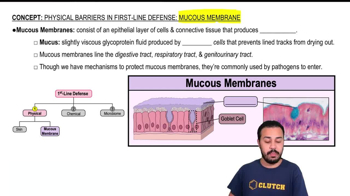
Mucous Membranes

Mucous membranes line various cavities and structures in the body, including the respiratory and digestive tracts. They are composed of epithelial tissue and are often associated with goblet cells, which produce mucus to protect and lubricate the surfaces. Recognizing the role of mucous membranes is essential for understanding where goblet cells are typically located.
Recommended video:
2:36
Mucous Membranes