Ch. 10 The Muscular System
Marieb - Human Anatomy & Physiology 7th Edition
Marieb, Hoehn7th EditionHuman Anatomy & PhysiologyISBN: 9780805359091Not the one you use?Change textbook
Chapter 10, Problem 21b

Name two muscles in each of the following compartments or regions:
f. Third muscle layer of the foot
g. Posterior compartment of leg
h. Medial compartment of thigh
i. Posterior compartment of thigh

Verified step by step guidance
1
Step 1: Understand the anatomical regions mentioned in the problem. The third muscle layer of the foot refers to the intrinsic muscles located deeper within the foot. The posterior compartment of the leg contains muscles primarily responsible for plantar flexion and toe flexion. The medial compartment of the thigh includes muscles involved in adduction of the thigh. The posterior compartment of the thigh contains muscles responsible for hip extension and knee flexion.
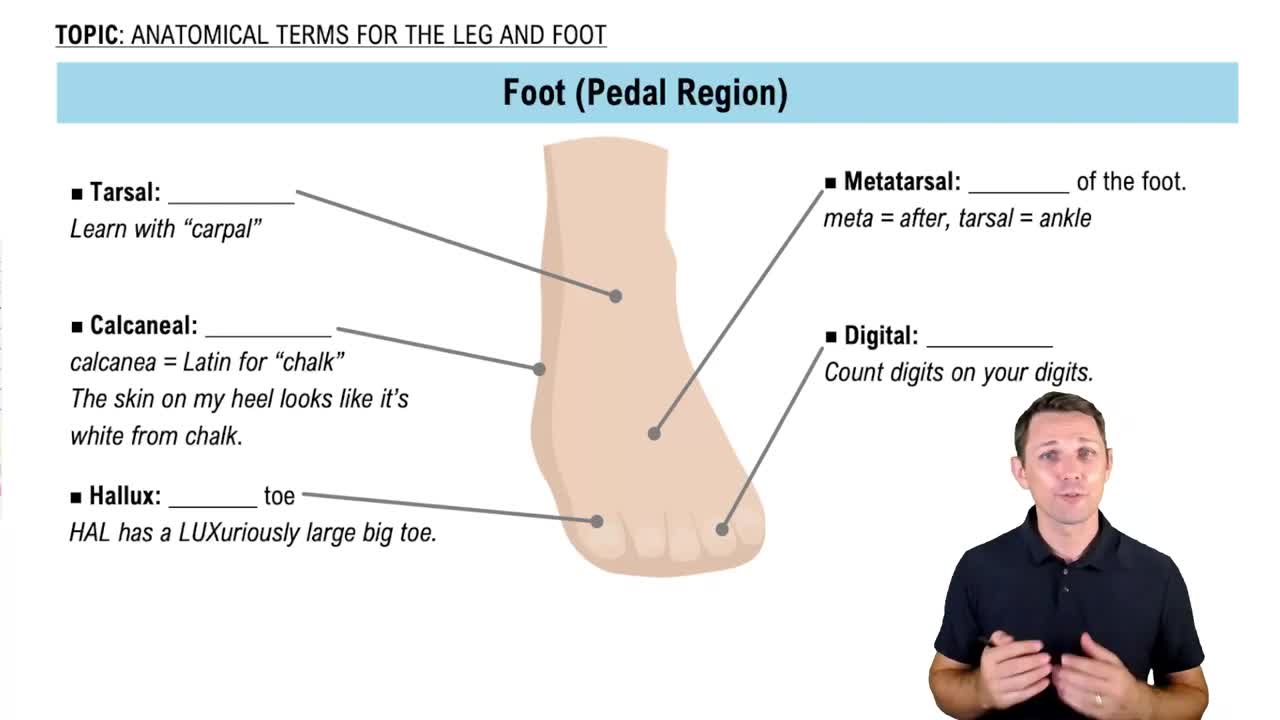
Step 2: Identify two muscles in the third muscle layer of the foot. These muscles are intrinsic and include the flexor hallucis brevis and adductor hallucis. The flexor hallucis brevis assists in flexing the big toe, while the adductor hallucis helps in adducting the big toe.
Step 3: Identify two muscles in the posterior compartment of the leg. These muscles include the gastrocnemius and soleus. Both are involved in plantar flexion of the foot, with the gastrocnemius also contributing to knee flexion.
Step 4: Identify two muscles in the medial compartment of the thigh. These muscles include the adductor longus and adductor magnus. Both are responsible for adducting the thigh and stabilizing the pelvis during movement.
Step 5: Identify two muscles in the posterior compartment of the thigh. These muscles include the biceps femoris and semitendinosus. Both are part of the hamstring group and are involved in hip extension and knee flexion.

Verified video answer for a similar problem:

This video solution was recommended by our tutors as helpful for the problem above.
Video duration:
2m
Was this helpful?

Key Concepts

Here are the essential concepts you must grasp in order to answer the question correctly.

Muscle Compartments

Muscle compartments are anatomical spaces in the body that contain groups of muscles with similar functions, innervation, and blood supply. Each compartment is surrounded by fascia, which helps to compartmentalize the muscles and can affect the spread of infections or injuries. Understanding these compartments is crucial for identifying specific muscles and their roles in movement.
Recommended video:
Guided course
2:00
Introduction to Muscles and Muscle Tissue Example 1

Muscles of the Foot

The foot has several layers of muscles, with the third layer primarily consisting of the adductor hallucis and the flexor hallucis brevis. These muscles are essential for the movement and stability of the toes, contributing to balance and propulsion during walking. Recognizing these muscles helps in understanding foot mechanics and pathology.
Recommended video:

Muscles of the Thigh and Leg

The thigh and leg are divided into compartments, each containing specific muscle groups. The medial compartment of the thigh includes muscles like the adductor longus and gracilis, while the posterior compartment of the thigh features the hamstrings, such as the biceps femoris. Knowledge of these muscles is vital for comprehending their functions in locomotion and their roles in various physical activities.
Recommended video:
Guided course
4:40
Bones of the Thigh and Leg
Related Practice
Textbook Question

Assume you have a 10-lb weight in your right hand. Explain why it is easier to flex the right elbow when your forearm is supinated than when it is pronated.

949
views
Textbook Question

Differentiate between the arrangement of elements (load, fulcrum, and effort) in first-, second-, and third-class levers.

1050
views
Textbook Question

Name two muscles in each of the following compartments or regions:

a. thenar eminence (ball of thumb)

b. posterior compartment of forearm

c. anterior compartment of forearm—deep muscle group

d. anterior muscle group in the arm

e. muscles of mastication

982
views
Textbook Question

a. Name the four muscle pairs that act in unison to compress the abdominal contents.

b. How does their arrangement (fiber direction) contribute to the strength of the abdominal wall?

c. Which of these muscles can effect lateral rotation of the spine?

d. Which can act alone to flex the spine?

1041
views
Textbook Question

As Kendra's coach watched her sail over the high jump bar, he contracted his right orbicularis oculi muscle, raised his arm, and contracted his opponens pollicis. Was he pleased or displeased with her performance? How do you know?

856
views
Textbook Question

When Mrs. O'Brien returned to her doctor for a follow-up visit after childbirth, she complained that she was incontinent (having problems controlling her urine flow) when she sneezed. The physician asked his nurse to give Mrs. O'Brien instructions on how to perform exercises to strengthen the muscles of the pelvic floor. To which muscles was he referring?

1043
views