Ch. 10 The Muscular System
Marieb - Human Anatomy & Physiology 7th Edition
Marieb, Hoehn7th EditionHuman Anatomy & PhysiologyISBN: 9780805359091Not the one you use?Change textbook
Chapter 10, Problem 22

When Mrs. O'Brien returned to her doctor for a follow-up visit after childbirth, she complained that she was incontinent (having problems controlling her urine flow) when she sneezed. The physician asked his nurse to give Mrs. O'Brien instructions on how to perform exercises to strengthen the muscles of the pelvic floor. To which muscles was he referring?

Verified step by step guidance
1
Understand the context: Mrs. O'Brien is experiencing stress urinary incontinence, which often occurs due to weakened pelvic floor muscles after childbirth.
Identify the relevant muscle group: The pelvic floor muscles primarily include the levator ani group (pubococcygeus, puborectalis, and iliococcygeus) and the coccygeus muscle, which support pelvic organs and help control urine flow.
Recognize the purpose of the exercises: Strengthening these muscles improves support for the bladder and urethra, enhancing voluntary control over urination, especially during activities that increase abdominal pressure like sneezing.
Relate to common exercise names: The physician likely referred to Kegel exercises, which involve repeated contraction and relaxation of the pelvic floor muscles to build strength and endurance.
Summarize: The muscles targeted are the pelvic floor muscles, mainly the levator ani group, which can be strengthened through specific exercises to reduce urinary incontinence.

Verified video answer for a similar problem:

This video solution was recommended by our tutors as helpful for the problem above.
Video duration:
1m
Was this helpful?

Key Concepts

Here are the essential concepts you must grasp in order to answer the question correctly.

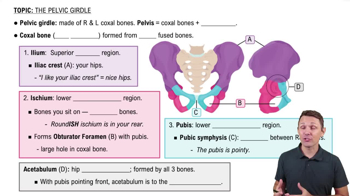
Pelvic Floor Muscles

The pelvic floor muscles are a group of muscles that support the pelvic organs, including the bladder, uterus, and rectum. They play a crucial role in maintaining continence by controlling the opening and closing of the urethra and anus. Strengthening these muscles can help prevent or reduce urinary incontinence, especially after childbirth.
Recommended video:
Guided course
8:07
Pelvic Girdle

Stress Urinary Incontinence

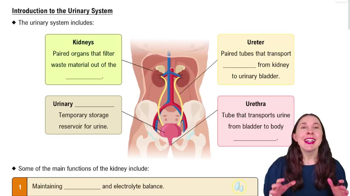
Stress urinary incontinence is the involuntary leakage of urine during activities that increase abdominal pressure, such as sneezing, coughing, or exercising. It often occurs when the pelvic floor muscles are weakened, which can happen after childbirth due to muscle stretching or nerve damage. Exercises targeting these muscles can improve control and reduce symptoms.
Recommended video:
2:57
The Urinary System

Kegel Exercises

Kegel exercises involve repeatedly contracting and relaxing the pelvic floor muscles to strengthen them. These exercises are commonly prescribed to women after childbirth to improve muscle tone and support for the bladder and urethra. Proper technique and regular practice can enhance muscle strength and help manage urinary incontinence.
Recommended video:
Guided course
4:08
Electrical Conduction System of the Heart Example 3
Related Practice
Textbook Question

Assume you have a 10-lb weight in your right hand. Explain why it is easier to flex the right elbow when your forearm is supinated than when it is pronated.

949
views
Textbook Question

Mr. Ahmadi, an out-of-shape 45-year-old man, was advised by his physician to lose weight and to exercise on a regular basis. He followed his diet faithfully and began to jog daily. One day, while on his morning jog, he heard a snapping sound that was immediately followed by a severe pain in his right lower calf. When his leg was examined, a gap was seen between his swollen upper calf region and his heel, and he was unable to plantar flex that ankle. What do you think happened? Why was the upper part of his calf swollen?

1049
views
Textbook Question

Name two muscles in each of the following compartments or regions:

a. thenar eminence (ball of thumb)

b. posterior compartment of forearm

c. anterior compartment of forearm—deep muscle group

d. anterior muscle group in the arm

e. muscles of mastication

982
views
Textbook Question

a. Name the four muscle pairs that act in unison to compress the abdominal contents.

b. How does their arrangement (fiber direction) contribute to the strength of the abdominal wall?

c. Which of these muscles can effect lateral rotation of the spine?

d. Which can act alone to flex the spine?

1041
views
Textbook Question

As Kendra's coach watched her sail over the high jump bar, he contracted his right orbicularis oculi muscle, raised his arm, and contracted his opponens pollicis. Was he pleased or displeased with her performance? How do you know?

856
views
Textbook Question

Name two muscles in each of the following compartments or regions:

f. Third muscle layer of the foot

g. Posterior compartment of leg

h. Medial compartment of thigh

i. Posterior compartment of thigh

1062
views