Ch. 18 The Cardiovascular System: The Heart
Marieb - Human Anatomy & Physiology 7th Edition
Marieb, Hoehn7th EditionHuman Anatomy & PhysiologyISBN: 9780805359091Not the one you use?Change textbook
Chapter 17, Problem 18

Describe how heart contraction and relaxation influence coronary blood flow
Name the major branches of the coronary arteries, and note the heart regions served by each

Verified step by step guidance
1
Understand that coronary blood flow is influenced by the phases of the cardiac cycle: systole (heart contraction) and diastole (heart relaxation). During systole, the myocardium contracts, compressing the coronary vessels and reducing blood flow, especially in the subendocardial regions.
During diastole, the heart muscle relaxes, relieving pressure on the coronary vessels and allowing blood to flow more freely through the coronary arteries. This phase is critical because most coronary perfusion occurs during diastole.
Identify the major branches of the coronary arteries starting with the left coronary artery (LCA), which typically divides into the left anterior descending artery (LAD) and the circumflex artery (LCx).
Note that the LAD supplies the anterior wall of the left ventricle, the anterior two-thirds of the interventricular septum, and the apex of the heart, while the circumflex artery supplies the lateral and posterior walls of the left ventricle.
Recognize the right coronary artery (RCA) as the other major branch, which supplies the right atrium, right ventricle, the posterior one-third of the interventricular septum, and often the sinoatrial (SA) and atrioventricular (AV) nodes, important for cardiac conduction.

Verified video answer for a similar problem:

This video solution was recommended by our tutors as helpful for the problem above.
Video duration:
2m
Was this helpful?

Key Concepts

Here are the essential concepts you must grasp in order to answer the question correctly.

Cardiac Cycle and Coronary Blood Flow

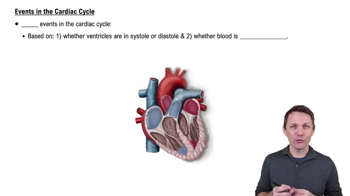
The cardiac cycle consists of systole (contraction) and diastole (relaxation). Coronary blood flow primarily occurs during diastole because the heart muscle relaxes, reducing pressure on coronary vessels and allowing blood to perfuse the myocardium. During systole, contraction compresses coronary vessels, limiting blood flow.
Recommended video:
Guided course
9:44
Events in the Cardiac Cycle

Major Coronary Arteries

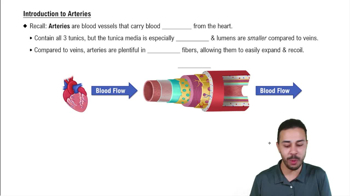
The two main coronary arteries are the left and right coronary arteries. The left coronary artery branches into the left anterior descending (LAD) and circumflex arteries, while the right coronary artery (RCA) supplies other regions. These arteries deliver oxygenated blood to specific heart areas.
Recommended video:
3:23
Introduction to Arteries

Regions Supplied by Coronary Artery Branches

The LAD artery supplies the anterior wall of the left ventricle and the interventricular septum. The circumflex artery supplies the lateral and posterior walls of the left ventricle. The RCA supplies the right atrium, right ventricle, and parts of the posterior left ventricle and conduction system.
Recommended video:
6:37
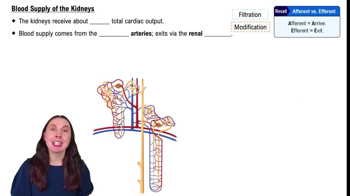
Blood Supply to the Kidneys
Related Practice
Textbook Question

The activity of the heart depends on intrinsic properties of cardiac muscle and on neural factors. Thus:

a. Vagus nerve stimulation of the heart reduces heart rate

b. Sympathetic nerve stimulation of the heart decreases time available for ventricular filling

c. Sympathetic stimulation of the heart increases its force of contraction

d. All of the above

1103
views
Textbook Question

Trace one drop of blood from the time it enters the right atrium until it enters the left atrium. What is this circuit called?

1030
views
Textbook Question

Discuss how the Frank-Starling law of the heart helps to explain the influence of venous return on stroke volume.

977
views
Textbook Question

Name the elements of the intrinsic conduction system of the heart in order, beginning with the pacemaker

What is the important function of this conduction system?

1602
views
Textbook Question

You have been called upon to demonstrate the technique for listening to valve sounds.

Explain where you would position your stethoscope to auscultate.

(1) the aortic valve of a patient with severe aortic valve insufficiency and

(2) a stenotic mitral valve.

During which period(s) would you hear these abnormal valve sounds most clearly? (During atrial diastole, ventricular systole, ventricular diastole, or atrial systole?)

What cues would you use to differentiate between an insufficient and a stenotic valve?

974
views
Textbook Question

Describe the pericardium and distinguish between the fibrous and the serous pericardia relative to histological structure and location.

1406
views