Ch. 18 The Cardiovascular System: The Heart
Marieb - Human Anatomy & Physiology 7th Edition
Marieb, Hoehn7th EditionHuman Anatomy & PhysiologyISBN: 9780805359091Not the one you use?Change textbook
Chapter 17, Problem 20

Discuss how the Frank-Starling law of the heart helps to explain the influence of venous return on stroke volume.

Verified step by step guidance
1
Begin by defining the Frank-Starling law of the heart: it states that the stroke volume of the heart increases in response to an increase in the volume of blood filling the heart (the end-diastolic volume), due to the stretching of cardiac muscle fibers.
Explain that venous return is the volume of blood returning to the heart via the veins, which directly affects the end-diastolic volume by determining how much blood fills the ventricles before contraction.
Describe how an increase in venous return leads to greater ventricular filling, which stretches the myocardial fibers more, enhancing their contractile force according to the Frank-Starling mechanism.
Illustrate that this increased contractile force results in a higher stroke volume, meaning the heart pumps out more blood with each beat to match the increased venous return, maintaining circulatory balance.
Conclude by emphasizing that the Frank-Starling law provides a physiological basis for how the heart automatically adjusts stroke volume in response to changes in venous return, ensuring efficient cardiac output.

Verified video answer for a similar problem:

This video solution was recommended by our tutors as helpful for the problem above.
Video duration:
5m
Was this helpful?

Key Concepts

Here are the essential concepts you must grasp in order to answer the question correctly.

Frank-Starling Law of the Heart

The Frank-Starling law states that the heart's stroke volume increases in response to an increase in the volume of blood filling the heart (end-diastolic volume). This occurs because stretching cardiac muscle fibers enhances their contractile force, allowing the heart to pump more blood with each beat.
Recommended video:
02:52
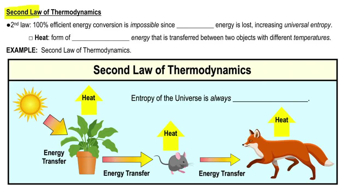
Second Law of Thermodynamics

Venous Return

Venous return is the flow of blood back to the heart from the veins. It directly affects the end-diastolic volume by determining how much blood fills the ventricles before contraction, thus influencing the heart's preload and subsequent stroke volume.
Recommended video:
6:50
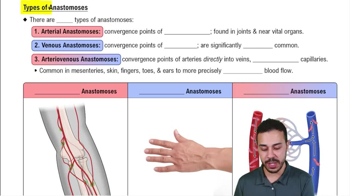
Types of Anastomoses

Stroke Volume

Stroke volume is the amount of blood ejected by the left ventricle during each heartbeat. It depends on factors like preload, contractility, and afterload, with preload being influenced by venous return as explained by the Frank-Starling mechanism.
Recommended video:
Guided course
6:28
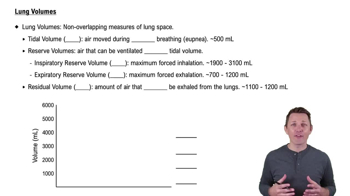
Lung Volumes
Related Practice
Textbook Question

Describe how heart contraction and relaxation influence coronary blood flow

Name the major branches of the coronary arteries, and note the heart regions served by each

882
views
Textbook Question

Trace one drop of blood from the time it enters the right atrium until it enters the left atrium. What is this circuit called?

1030
views
Textbook Question

Name the elements of the intrinsic conduction system of the heart in order, beginning with the pacemaker

What is the important function of this conduction system?

1602
views
Textbook Question

You have been called upon to demonstrate the technique for listening to valve sounds.

Explain where you would position your stethoscope to auscultate.

(1) the aortic valve of a patient with severe aortic valve insufficiency and

(2) a stenotic mitral valve.

During which period(s) would you hear these abnormal valve sounds most clearly? (During atrial diastole, ventricular systole, ventricular diastole, or atrial systole?)

What cues would you use to differentiate between an insufficient and a stenotic valve?

974
views
Textbook Question

Florita Santos, a middle-aged woman, is admitted to the coronary care unit with a diagnosis of left ventricular failure resulting from a myocardial infarction. Her history indicates that she awoke in the middle of the night with severe chest pain. Her skin is pale and cold, and moist sounds are heard over the lower regions of both lungs. Explain how failure of the left ventricle can cause these signs and symptoms.

1170
views