Ch. 10 Muscle Tissue
Martini - Fundamentals of Anatomy & Physiology 11th Edition
Martini, Nath, Bartholomew11th EditionFundamentals of Anatomy & PhysiologyISBN: 9780136874089Not the one you use?Change textbook
Chapter 10, Problem 10

What three layers of connective tissue are part of each muscle? What functional role does each layer play?

Verified step by step guidance
1
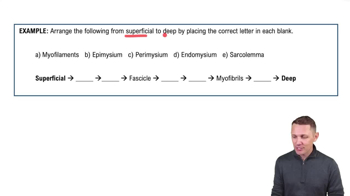
Identify the three layers of connective tissue associated with each muscle: the epimysium, perimysium, and endomysium.
Understand that the epimysium is the outermost layer that surrounds the entire muscle, providing protection and helping to maintain the muscle's overall shape.
Recognize that the perimysium surrounds bundles of muscle fibers called fascicles, organizing the muscle into functional units and allowing blood vessels and nerves to reach the muscle fibers.
Know that the endomysium is the innermost layer, surrounding individual muscle fibers, providing an environment for exchange of nutrients and waste, and helping to transmit the force generated by muscle fibers to the connective tissue.
Summarize the functional roles: epimysium protects and shapes the muscle, perimysium organizes muscle fibers into fascicles and supports vascular and nerve supply, and endomysium supports individual muscle fibers and aids in force transmission.

Verified video answer for a similar problem:

This video solution was recommended by our tutors as helpful for the problem above.
Video duration:
4m
Was this helpful?

Key Concepts

Here are the essential concepts you must grasp in order to answer the question correctly.

Epimysium

The epimysium is the outermost layer of connective tissue surrounding the entire muscle. It protects the muscle from friction against other muscles and bones, and helps maintain the muscle's structural integrity during contraction.
Recommended video:
Guided course
2:46
Structure of a Skeletal Muscle Example 2

Perimysium

The perimysium is the connective tissue layer that surrounds bundles of muscle fibers called fascicles. It provides pathways for nerves and blood vessels to reach the muscle fibers and contributes to the muscle's strength and elasticity.
Recommended video:
Guided course
7:12
Organization of Muscle Tissue

Endomysium

The endomysium is the innermost connective tissue layer that surrounds individual muscle fibers. It supports and nourishes each muscle cell by housing capillaries and nerve fibers, and facilitates the transmission of contractile force.
Recommended video:
Guided course
2:46
Structure of a Skeletal Muscle Example 2