Ch. 11 The Muscular System
Martini - Fundamentals of Anatomy & Physiology 11th Edition
Martini, Nath, Bartholomew11th EditionFundamentals of Anatomy & PhysiologyISBN: 9780136874089Not the one you use?Change textbook
Chapter 11, Problem 30

Mary's newborn is having trouble suckling. The doctor suggests that it may be a problem with a particular muscle. What muscle is the doctor probably referring to?
(a) Orbicularis oris
(b) Buccinator
(c) Masseter
(d) Risorius
(e) Zygomaticus

Verified step by step guidance
1
Step 1: Understand the function of suckling in newborns. Suckling involves creating a seal around the nipple and generating suction to draw milk. This requires coordination of facial muscles.
Step 2: Review the functions of the listed muscles: (a) Orbicularis oris is responsible for closing the lips and forming a seal, which is essential for suckling. (b) Buccinator helps compress the cheeks, aiding in suction. (c) Masseter is a chewing muscle, primarily involved in mastication, not suckling. (d) Risorius is involved in facial expressions, such as smiling, and does not contribute to suckling. (e) Zygomaticus also contributes to facial expressions, like smiling, and is not directly involved in suckling.
Step 3: Eliminate muscles that are not directly involved in suckling. Based on their functions, masseter, risorius, and zygomaticus can be ruled out.
Step 4: Focus on the orbicularis oris and buccinator muscles. Both play roles in suckling, but the orbicularis oris is particularly critical for forming a seal around the nipple, which is the primary action required for suckling.
Step 5: Conclude that the doctor is likely referring to the orbicularis oris muscle, as it is the most essential muscle for creating the seal necessary for suckling.

Verified video answer for a similar problem:

This video solution was recommended by our tutors as helpful for the problem above.
Video duration:
2m
Was this helpful?

Key Concepts

Here are the essential concepts you must grasp in order to answer the question correctly.

Muscles Involved in Suckling

Suckling in newborns primarily involves muscles that control lip closure and cheek tension to create suction. The orbicularis oris muscle encircles the mouth and is essential for sealing the lips, enabling effective suckling. Understanding which muscles contribute to this action helps identify potential issues in feeding.
Recommended video:
Guided course
2:00
Introduction to Muscles and Muscle Tissue Example 1

Function of the Orbicularis Oris Muscle

The orbicularis oris is a complex muscle around the mouth that controls lip movements such as puckering and closing. It plays a critical role in forming a tight seal necessary for suckling and breastfeeding. Dysfunction in this muscle can lead to difficulties in creating suction.
Recommended video:
06:04
Functional Groups

Role of Buccinator and Other Facial Muscles

The buccinator muscle helps compress the cheeks against the teeth, aiding in manipulating food and maintaining pressure during suckling. Other muscles like the masseter, risorius, and zygomaticus have roles in chewing and facial expression but are less directly involved in suckling mechanics.
Recommended video:
Guided course
5:41
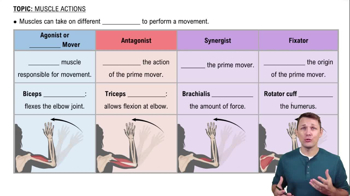
Muscle Actions