Ch. 12 Nervous Tissue
Martini - Fundamentals of Anatomy & Physiology 11th Edition
Martini, Nath, Bartholomew11th EditionFundamentals of Anatomy & PhysiologyISBN: 9780136874089Not the one you use?Change textbook
Chapter 12, Problem 11

What three functional groups of neurons are found in the nervous system? What is the function of each type of neuron?

Verified step by step guidance
1
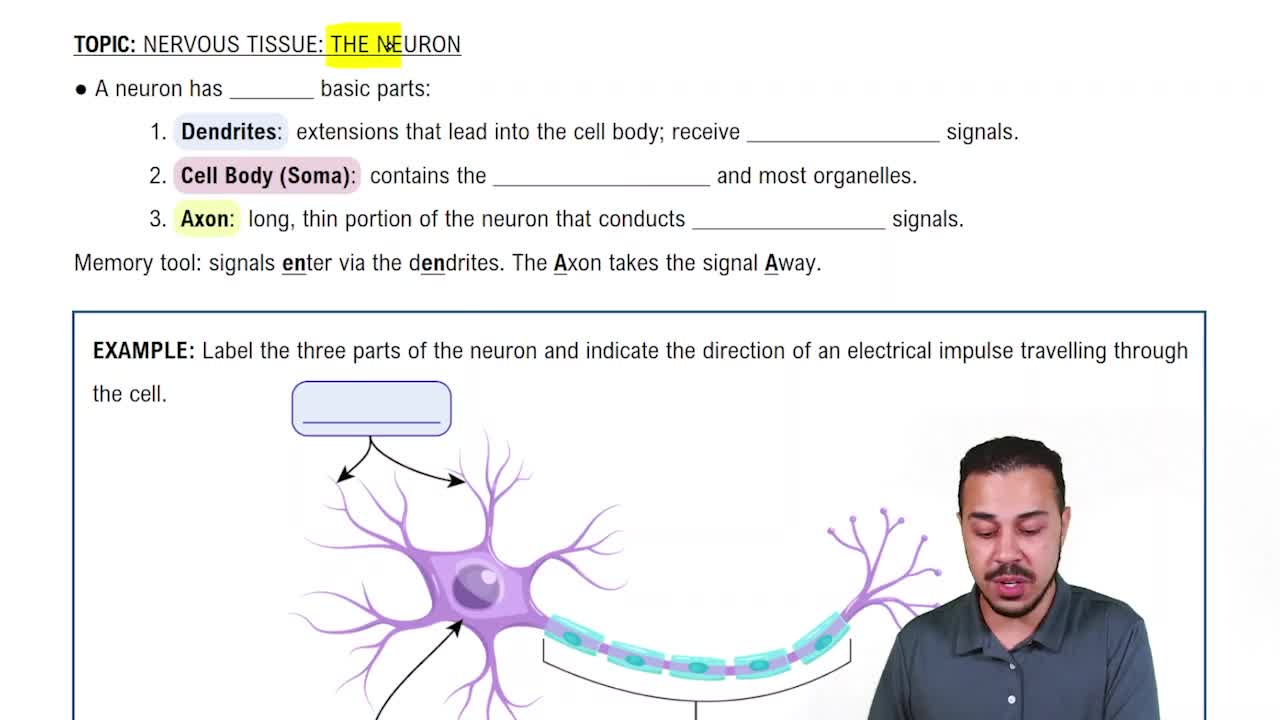
Identify the three main functional groups of neurons in the nervous system: sensory neurons, motor neurons, and interneurons.
Explain that sensory neurons (also called afferent neurons) carry information from sensory receptors toward the central nervous system (CNS), allowing the body to perceive stimuli.
Describe motor neurons (also called efferent neurons) as neurons that transmit signals away from the CNS to effector organs such as muscles and glands, enabling a response or action.
Define interneurons as neurons located entirely within the CNS that connect sensory and motor neurons, facilitating communication and integration of information.
Summarize the roles: sensory neurons detect stimuli, interneurons process and interpret information, and motor neurons execute responses.

Verified video answer for a similar problem:

This video solution was recommended by our tutors as helpful for the problem above.
Video duration:
2m
Was this helpful?

Key Concepts

Here are the essential concepts you must grasp in order to answer the question correctly.

Sensory Neurons

Sensory neurons transmit information from sensory receptors (like skin, eyes, ears) to the central nervous system. They detect stimuli such as touch, light, and sound, converting these signals into electrical impulses for processing.
Recommended video:

Interneurons

Interneurons are located within the central nervous system and act as connectors between sensory and motor neurons. They process and interpret sensory input, enabling complex functions like reflexes, decision-making, and coordination.
Recommended video:
1:03
Visceral Reflex Arcs Example 1

Motor Neurons

Motor neurons carry signals from the central nervous system to muscles or glands, triggering responses such as muscle contraction or secretion. They are essential for executing voluntary and involuntary movements.
Recommended video: