Ch. 21 Blood Vessels and Circulation
Martini - Fundamentals of Anatomy & Physiology 11th Edition
Martini, Nath, Bartholomew11th EditionFundamentals of Anatomy & PhysiologyISBN: 9780136874089Not the one you use?Change textbook
Chapter 21, Problem 6

Large molecules such as peptides and proteins move into and out of the bloodstream by way of:
(a) Continuous capillaries
(b) Fenestrated capillaries
(c) Thoroughfare channels
(d) Venules

Verified step by step guidance
1
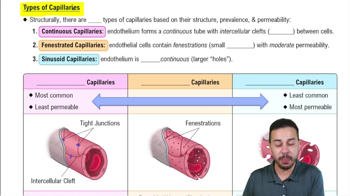
Step 1: Understand the structure and function of different types of capillaries. Continuous capillaries have tightly joined endothelial cells with small intercellular clefts, allowing only small molecules to pass through, but restricting large molecules like peptides and proteins.
Step 2: Examine fenestrated capillaries, which have pores (fenestrations) in their endothelial lining. These pores allow for increased permeability, enabling larger molecules such as peptides and proteins to move more easily between the bloodstream and surrounding tissues.
Step 3: Consider thoroughfare channels, which are direct pathways through capillary beds that primarily regulate blood flow rather than molecular exchange. They are not specialized for the movement of large molecules.
Step 4: Review venules, which are small veins that collect blood from capillaries. While venules can allow some exchange, they are not the primary site for the movement of large molecules into and out of the bloodstream.
Step 5: Conclude that fenestrated capillaries are the primary type of capillaries that facilitate the movement of large molecules such as peptides and proteins due to their porous structure.

Verified video answer for a similar problem:

This video solution was recommended by our tutors as helpful for the problem above.
Video duration:
2m
Was this helpful?

Key Concepts

Here are the essential concepts you must grasp in order to answer the question correctly.

Types of Capillaries

Capillaries are small blood vessels that facilitate exchange between blood and tissues. There are three main types: continuous, fenestrated, and sinusoidal. Continuous capillaries have tight junctions and allow only small molecules to pass, while fenestrated capillaries have pores that permit larger molecules like peptides and proteins to move through.
Recommended video:
9:42
Types of Capillaries

Fenestrated Capillaries and Molecular Transport

Fenestrated capillaries contain small pores (fenestrations) in their endothelial lining, which increase permeability. These pores enable larger molecules such as peptides and proteins to pass between the bloodstream and surrounding tissues, making fenestrated capillaries essential in organs requiring rapid exchange, like kidneys and endocrine glands.
Recommended video:
9:42
Types of Capillaries

Role of Venules and Thoroughfare Channels

Venules are small veins that collect blood from capillaries, primarily involved in blood return rather than molecular exchange. Thoroughfare channels are direct pathways connecting arterioles to venules, bypassing capillary beds, and do not facilitate significant molecular exchange. Thus, they are less relevant for the movement of large molecules.
Recommended video:
7:24
Anastomoses Form Collateral Channels