Ch. 21 Blood Vessels and Circulation
Martini - Fundamentals of Anatomy & Physiology 11th Edition
Martini, Nath, Bartholomew11th EditionFundamentals of Anatomy & PhysiologyISBN: 9780136874089Not the one you use?Change textbook
Chapter 21, Problem 9

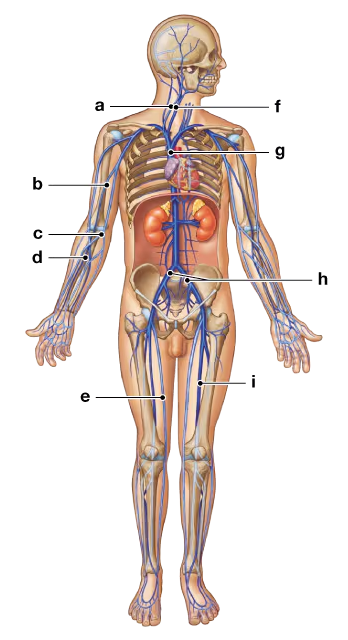
Identify the major veins in the following diagram.
Diagram of the human body highlighting major veins with labeled points from head to legs for identification.
a. ___
b. ___
c. ___
d. ___
e. ___
f. ___
g. ___
h. ___
i. ___

Verified step by step guidance
1
Step 1: Review the diagram carefully and locate the veins labeled from a to i. Familiarize yourself with the general layout of the venous system in the human body, noting common major veins such as the superior vena cava, inferior vena cava, jugular veins, subclavian veins, and others.
Step 2: Identify the veins in the head and neck region first, such as the internal and external jugular veins, which typically drain blood from the brain and face back toward the heart.
Step 3: Move to the thoracic region and identify major veins like the superior vena cava, which collects blood from the upper body, and the subclavian veins, which drain the arms.
Step 4: Look for veins in the abdominal and lower limb regions, such as the inferior vena cava, which returns blood from the lower body, and the femoral or great saphenous veins in the legs.
Step 5: Cross-reference your observations with a standard anatomical reference or textbook to confirm the names of each vein corresponding to the labels a through i, ensuring accuracy in identification.

Verified video answer for a similar problem:

This video solution was recommended by our tutors as helpful for the problem above.
Was this helpful?

Key Concepts

Here are the essential concepts you must grasp in order to answer the question correctly.

Anatomy of Major Veins

Understanding the structure and location of major veins is essential for identifying them in diagrams. Major veins include the superior and inferior vena cava, jugular veins, and femoral veins, which return deoxygenated blood to the heart. Recognizing their anatomical positions helps in accurate identification.
Recommended video:
6:24
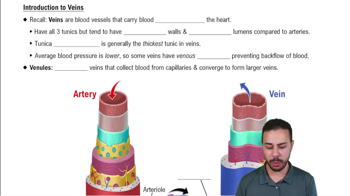
Introduction to Veins

Venous System Function

The venous system carries deoxygenated blood from various body parts back to the heart. Knowing the function of veins aids in distinguishing them from arteries in diagrams, as veins typically have thinner walls and valves to prevent backflow, which is important for correct labeling.
Recommended video:
06:04
Functional Groups

Diagram Interpretation Skills

Interpreting anatomical diagrams requires familiarity with common labeling conventions and spatial relationships between structures. Skills in reading diagrams help in matching visual cues with anatomical knowledge to correctly identify and name the veins shown.
Recommended video:
3:17
The Cerebrum