Ch. 21 Blood Vessels and Circulation
Martini - Fundamentals of Anatomy & Physiology 11th Edition
Martini, Nath, Bartholomew11th EditionFundamentals of Anatomy & PhysiologyISBN: 9780136874089Not the one you use?Change textbook
Chapter 21, Problem 10

The most important factor in vascular resistance is:
(a) The viscosity of the blood
(b) The diameter of the lumen of blood vessels
(c) Turbulence due to irregular surfaces of blood vessels
(d) The length of the blood vessels

Verified step by step guidance
1
Understand that vascular resistance is the opposition to blood flow within blood vessels, and it is influenced by several factors including blood viscosity, vessel length, vessel diameter, and turbulence.
Recall Poiseuille's law, which describes how resistance (R) to flow in a vessel is related to these factors. The formula is: \(R = \frac{8 \eta L}{\pi r^4}\), where \(\eta\) is the viscosity, \(L\) is the length of the vessel, and \(r\) is the radius of the vessel.
Note that resistance is inversely proportional to the fourth power of the radius (\(r^4\)), meaning small changes in vessel diameter have a large effect on resistance.
Compare the impact of each factor: viscosity and length affect resistance linearly, while diameter affects it exponentially (to the fourth power), and turbulence can increase resistance but is generally less significant under normal conditions.
Conclude that the diameter of the lumen (vessel radius) is the most important factor in determining vascular resistance because of its exponential effect on resistance.

Verified video answer for a similar problem:

This video solution was recommended by our tutors as helpful for the problem above.
Was this helpful?

Key Concepts

Here are the essential concepts you must grasp in order to answer the question correctly.

Vascular Resistance

Vascular resistance refers to the opposition that blood vessels offer to blood flow. It is a key determinant of blood pressure and flow rate, influenced by factors such as vessel diameter, blood viscosity, vessel length, and flow characteristics.
Recommended video:
Guided course
6:55
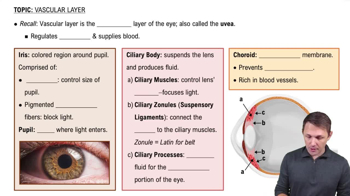
Vascular Layer

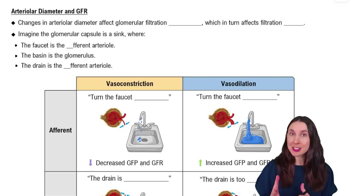
Diameter of the Lumen

The diameter of the blood vessel lumen is the most critical factor affecting vascular resistance. According to Poiseuille’s law, resistance is inversely proportional to the fourth power of the radius, meaning small changes in diameter cause large changes in resistance.
Recommended video:
4:33
Arteriolar Diameter and GFR

Blood Viscosity and Vessel Length

Blood viscosity is the thickness or stickiness of blood, which affects resistance but less significantly than lumen diameter. Vessel length also influences resistance, with longer vessels increasing resistance, but this factor is relatively constant in the body.
Recommended video:
4:59
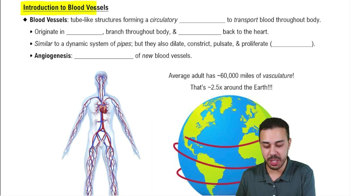
Blood Vessels