Ch. 29 Development and Inheritance
Martini - Fundamentals of Anatomy & Physiology 11th Edition
Martini, Nath, Bartholomew11th EditionFundamentals of Anatomy & PhysiologyISBN: 9780136874089Not the one you use?Change textbook
Chapter 28, Problem 23a

Distinguish between the following paired terms: 
(a) genotype and phenotype, 

Verified step by step guidance
1
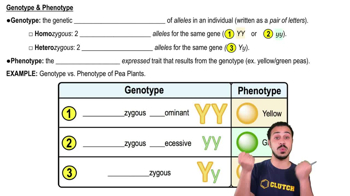
Understand the definitions of the terms: Genotype refers to the genetic makeup of an organism, specifically the set of genes it carries. Phenotype refers to the observable physical or biochemical characteristics of an organism, which result from the interaction of its genotype with the environment.
Recognize the relationship between the two: The genotype provides the instructions (genetic code) for the development of traits, while the phenotype is the expression of those traits as influenced by both genetic and environmental factors.
Consider examples to clarify the distinction: For instance, in humans, the genotype might include a gene for eye color (e.g., a combination of alleles for brown or blue eyes), while the phenotype would be the actual eye color observed (e.g., brown eyes).
Acknowledge the role of environmental factors: While the genotype is fixed at conception, the phenotype can be influenced by external factors such as nutrition, temperature, or exposure to sunlight, which can modify the expression of certain traits.
Summarize the distinction: Genotype is the underlying genetic code, while phenotype is the outward expression of that code, shaped by both genetic and environmental influences.

Verified video answer for a similar problem:

This video solution was recommended by our tutors as helpful for the problem above.
Was this helpful?

Key Concepts

Here are the essential concepts you must grasp in order to answer the question correctly.

Genotype

Genotype refers to the genetic constitution of an organism, encompassing all the alleles inherited from its parents. It represents the specific set of genes that an individual carries, which can influence various traits. For example, an individual may have a genotype for eye color that includes alleles for blue and brown eyes, but this does not directly determine the observable trait.
Recommended video:
06:36
Genotype & Phenotype

Phenotype

Phenotype is the observable physical and physiological traits of an organism, resulting from the interaction of its genotype with the environment. This includes characteristics such as height, eye color, and behavior. For instance, two individuals with the same genotype for a trait may exhibit different phenotypes due to environmental factors like nutrition or climate.
Recommended video:
06:36
Genotype & Phenotype

Gene-Environment Interaction

Gene-environment interaction refers to the way in which environmental factors can influence the expression of genes, thereby affecting the phenotype. This concept highlights that while the genotype provides the potential for certain traits, the actual expression of these traits can vary significantly based on environmental conditions. For example, a plant's growth may be limited by soil quality, even if it has the genetic potential to grow tall.
Recommended video:
Guided course
2:39
Intracellular Receptors and Direct Gene Action Example 1