Ch. 4 The Tissue Level of Organization
Martini - Fundamentals of Anatomy & Physiology 11th Edition
Martini, Nath, Bartholomew11th EditionFundamentals of Anatomy & PhysiologyISBN: 9780136874089Not the one you use?Change textbook
Chapter 4, Problem 3

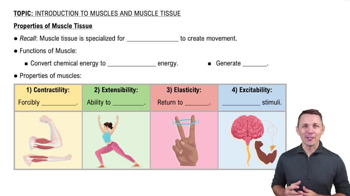
Tissue that is specialized for contraction is
(a) Epithelial tissue
(b) Muscle tissue
(c) Connective tissue
(d) Nervous tissue

Verified step by step guidance
1
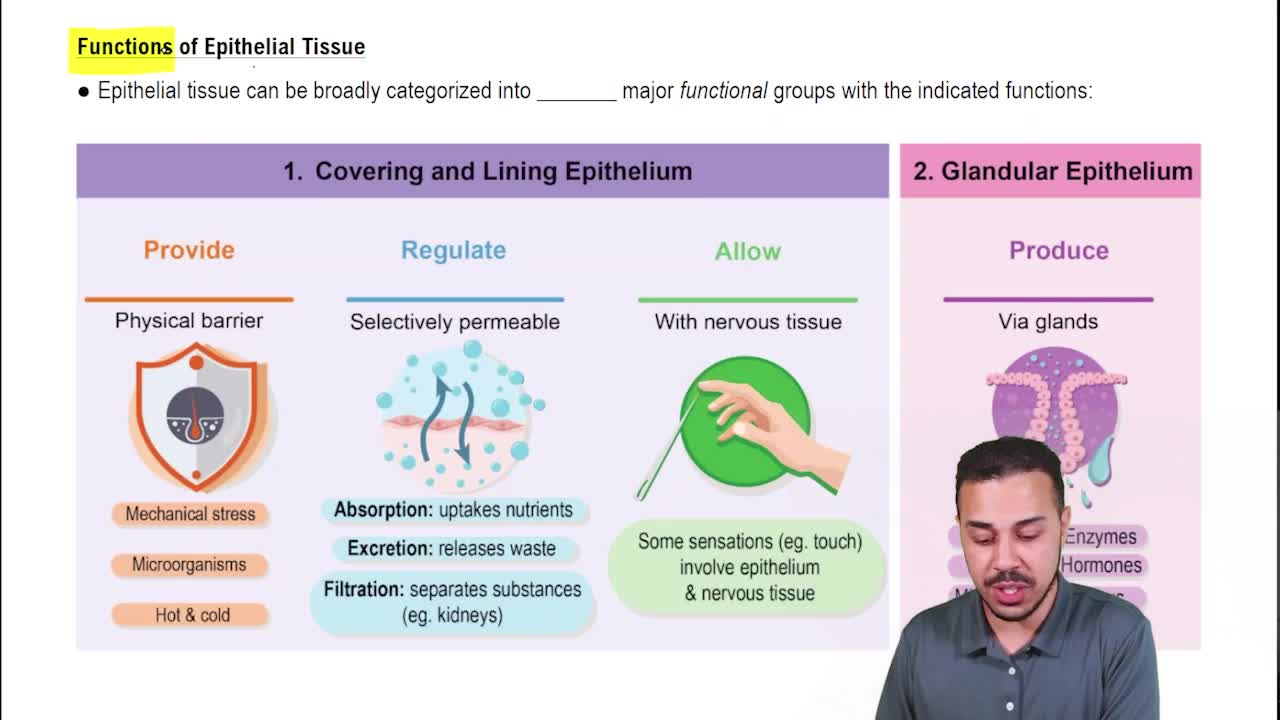
Step 1: Understand the function of each tissue type listed in the options. Epithelial tissue covers body surfaces and lines cavities, providing protection and absorption.
Step 2: Recognize that connective tissue supports and binds other tissues together, providing structure and protection.
Step 3: Know that nervous tissue is specialized for transmitting electrical signals and communication within the body.
Step 4: Identify that muscle tissue is specialized for contraction, which allows movement of body parts and organs.
Step 5: Conclude that the tissue specialized for contraction is muscle tissue, based on its unique ability to shorten and generate force.

Verified video answer for a similar problem:

This video solution was recommended by our tutors as helpful for the problem above.
Video duration:
2m
Was this helpful?

Key Concepts

Here are the essential concepts you must grasp in order to answer the question correctly.

Muscle Tissue

Muscle tissue is specialized for contraction, enabling movement and force generation in the body. It consists of cells called muscle fibers that can shorten and produce motion, such as in skeletal, cardiac, and smooth muscles.
Recommended video:
Guided course
4:36
Properties of Muscle Tissue

Epithelial Tissue

Epithelial tissue forms protective layers covering body surfaces and lining cavities. It serves as a barrier and is involved in absorption, secretion, and sensation, but it is not specialized for contraction.
Recommended video:
Guided course
07:25
Functions of Epithelial Tissue

Connective and Nervous Tissues

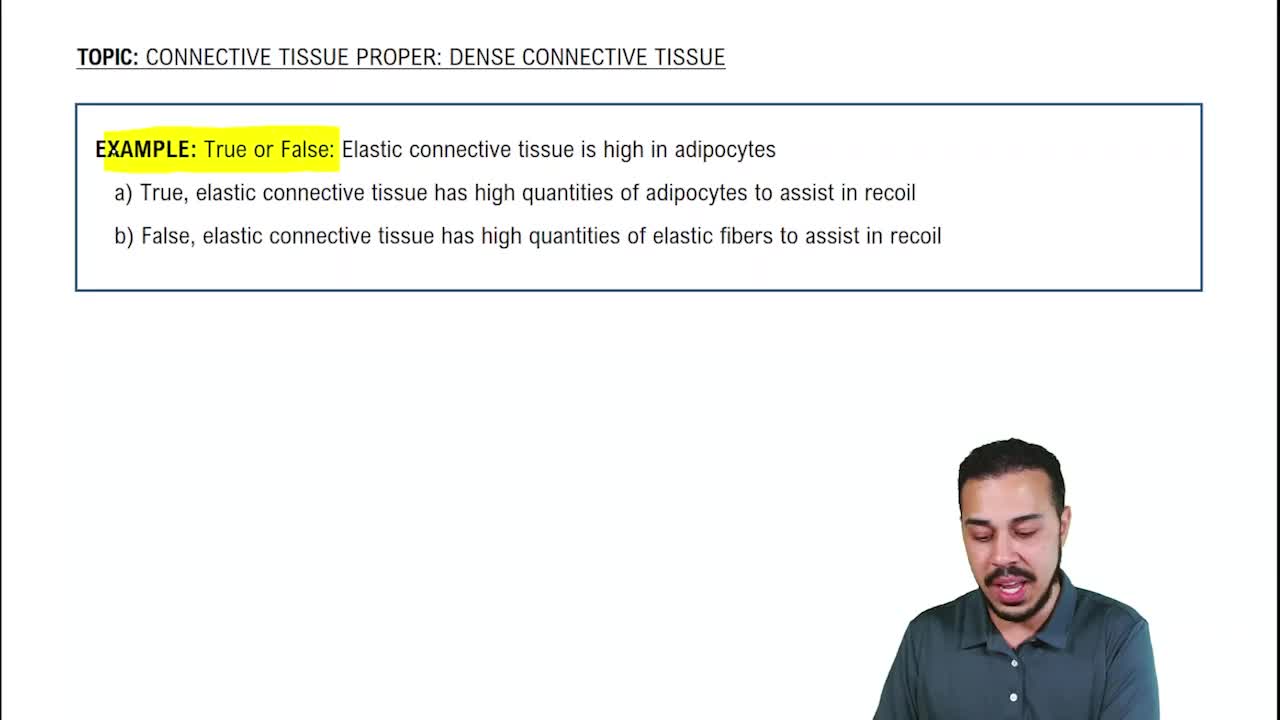
Connective tissue supports and binds other tissues, providing structure and protection, while nervous tissue transmits electrical signals for communication. Neither is primarily responsible for contraction.
Recommended video:
Guided course
01:27
Connective Tissue Proper: Dense Connective Tissue Example 3