 Back
BackSolving Linear Equations with Fractions and Decimals
Study Guide - Smart Notes
 Tailored notes based on your materials, expanded with key definitions, examples, and context.
Solving Linear Equations and Inequalities
Solving Equations with Fractions
Linear equations often contain fractions, which can make solving them more complex. The key strategy is to eliminate fractions by multiplying both sides of the equation by the least common denominator (LCD).
Step 1: Identify the LCD of all denominators in the equation.
Step 2: Multiply every term on both sides by the LCD to clear fractions.
Step 3: Use the distributive property to remove parentheses.
Step 4: Combine like terms and isolate the variable.
Step 5: Solve for the variable and check your solution.
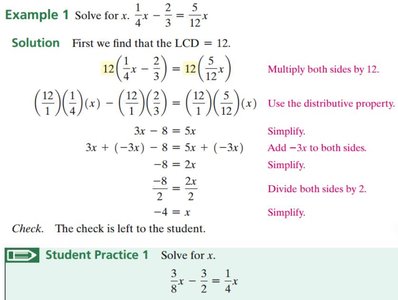
Example 1
Solve for x:
LCD is 12. Multiply both sides by 12:
Simplify:
Subtract from both sides:
Divide by 2:
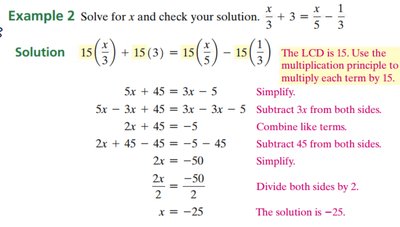
Example 2
Solve for x and check your solution:
LCD is 15. Multiply each term by 15:
Simplify:
Subtract from both sides:
Subtract 45:
Divide by 2:
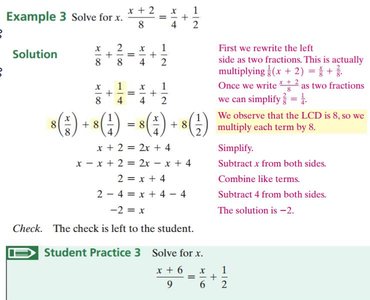
Example 3
Solve for x:
Rewrite left side as two fractions.
LCD is 8. Multiply each term by 8:
Simplify:
Subtract from both sides:
Subtract 4:
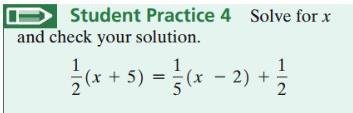
Student Practice Problems
Solve for x:
Solve for x and check your solution:

Solve for x:
Solve for x and check your solution:
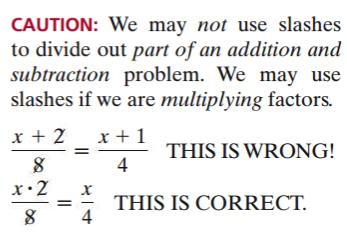
Important Caution When Working with Fractions
When simplifying expressions with fractions, it is important to remember:
Do not divide out part of an addition or subtraction problem using slashes.
Slashes may be used only when multiplying factors.
For example:
(This is incorrect!)
(This is correct.)
Solving Equations with Decimals
Equations with decimals can be simplified by multiplying each term by a power of 10 to eliminate the decimal points.
Step 1: Remove parentheses using the distributive property.
Step 2: Multiply each term by 10 (or 100, etc.) to clear decimals.
Step 3: Combine like terms and solve for the variable.
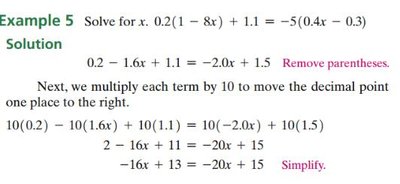
Example 5
Solve for x:
Remove parentheses:
Multiply each term by 10:
Simplify:
Procedure for Solving Linear Equations
Follow these steps to solve linear equations efficiently:
Remove any parentheses.
If fractions exist, multiply all terms by the LCD.
Combine like terms, if possible.
Add or subtract terms to get all variable terms on one side.
Add or subtract constants to get all non-variable terms on the other side.
Divide both sides by the coefficient of the variable.
Simplify the solution.
Check your solution.
Special Cases: No Solution and Infinite Solutions
Not every equation has a single solution. Some equations have no solution, while others have infinitely many solutions.
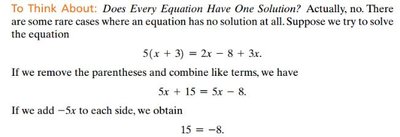
No Solution: Occurs when the equation simplifies to a false statement (e.g., ).
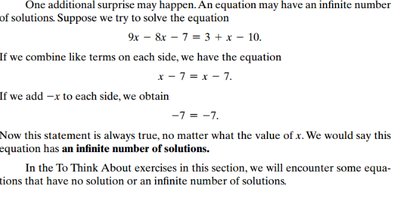
Infinite Solutions: Occurs when the equation simplifies to a true statement for all values of the variable (e.g., ).
Example: No Solution
Solve:
Combine like terms:
Subtract : (False statement)
No solution exists.
Example: Infinite Solutions
Solve:
Combine like terms:
Subtract : (True for all x)
Infinite number of solutions.
Summary Table: Types of Solutions for Linear Equations
Type of Solution | Example | Result |
|---|---|---|
One Solution | ||
No Solution | False statement () | |
Infinite Solutions | True statement () |
Additional info: These notes expand on the examples and procedures from the provided slides and textbook images, ensuring a self-contained guide for beginning algebra students.
