 Back
BackGuidance for Rational Inequality and Complex Number Division
Study Guide - Smart Notes
 Tailored notes based on your materials, expanded with key definitions, examples, and context.
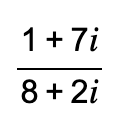
Q1. Simplify the expression: \( \frac{1 + 7i}{8 + 2i} \)
Background
Topic: Complex Numbers
This question is testing your ability to divide complex numbers and write the result in standard form (\( a + bi \)).
Key Terms and Formulas
Complex number: An expression of the form \( a + bi \), where \( a \) and \( b \) are real numbers and \( i \) is the imaginary unit (\( i^2 = -1 \)).
Standard form: \( a + bi \).
To divide complex numbers, multiply numerator and denominator by the conjugate of the denominator.
Key formula:
Conjugate of \( 8 + 2i \) is \( 8 - 2i \).
Multiply numerator and denominator by the conjugate:
Step-by-Step Guidance
Write the conjugate of the denominator: \( 8 - 2i \).
Multiply both the numerator and denominator by the conjugate:
in the numerator and in the denominator.
Expand the numerator using the distributive property:
Expand the denominator using the difference of squares:
Try solving on your own before revealing the answer!
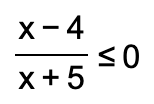
Q2. Solve the rational inequality: \( \frac{x - 4}{x + 5} \leq 0 \)
Background
Topic: Rational Inequalities
This question is testing your ability to solve rational inequalities and express the solution set in interval notation.
Key Terms and Formulas
Rational inequality: An inequality involving a rational expression (a fraction with polynomials in numerator and denominator).
Interval notation: A way to describe the set of solutions using intervals.
Key formula:
To solve \( \frac{x - 4}{x + 5} \leq 0 \), find where the expression is zero or negative.
Step-by-Step Guidance
Identify the critical points by setting the numerator and denominator equal to zero:
and
Find the values of \( x \) where the expression is undefined or equals zero.
Set up intervals based on the critical points and test values in each interval to determine where the expression is less than or equal to zero.
Remember to exclude values that make the denominator zero from the solution set.
Try solving on your own before revealing the answer!
Final Answer for Q1:
After simplifying, the result is .
Final Answer for Q2:
The solution set is (excluding where the expression is undefined).
We found the intervals where the rational expression is less than or equal to zero and wrote the answer in interval notation.
