 Back
BackGuidance for Rational Inequality Problem
Study Guide - Smart Notes
 Tailored notes based on your materials, expanded with key definitions, examples, and context.
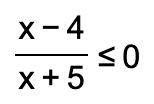
Q1. Solve the rational inequality: \( \frac{x-4}{x+5} \leq 0 \)
Background
Topic: Rational Inequalities
This question tests your ability to solve inequalities involving rational expressions, and to express the solution set in interval notation.
Key Terms and Formulas:
Rational Expression: An expression of the form \( \frac{P(x)}{Q(x)} \), where \(P(x)\) and \(Q(x)\) are polynomials.
Critical Points: Values of \(x\) where the numerator or denominator is zero.
Interval Notation: A way to describe the set of solutions using intervals.
Step-by-Step Guidance
Identify the critical points by setting the numerator and denominator equal to zero: \(x-4=0\) and \(x+5=0\).
Solve for \(x\) in both equations to find the critical points.
Use these critical points to divide the real number line into intervals. Test each interval to determine where the rational expression is less than or equal to zero.
Remember that the denominator cannot be zero, so exclude \(x=-5\) from your solution set.
Try solving on your own before revealing the answer!
Final Answer: \((-\infty, -5) \cup [4, \infty)\)
We found the critical points at \(x=-5\) and \(x=4\), tested the intervals, and wrote the solution in interval notation, excluding \(x=-5\) where the denominator is zero.
