 Back
BackPrealgebra Review: Adding and Subtracting Fractions
Study Guide - Smart Notes
 Tailored notes based on your materials, expanded with key definitions, examples, and context.
Chapter 0: Prealgebra Review
Section 0.2: Adding and Subtracting Fractions
This section reviews the foundational skills needed to add and subtract fractions, including those with common and uncommon denominators, as well as mixed numbers. Mastery of these skills is essential for success in algebra and higher-level mathematics.
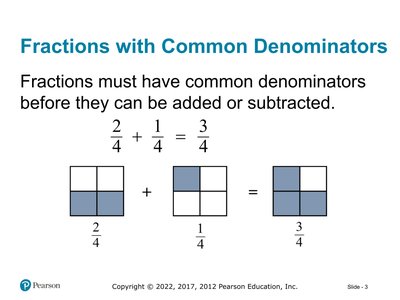
Fractions with Common Denominators
Fractions must have the same denominator before they can be added or subtracted. The denominator represents the number of equal parts the whole is divided into, and the numerator indicates how many of those parts are considered.
Key Point 1: Only fractions with the same denominator can be directly added or subtracted.
Key Point 2: Add or subtract the numerators, keeping the denominator unchanged.
Example:
Steps to Add or Subtract Two Fractions with a Common Denominator
Follow these steps when working with fractions that already share a denominator:
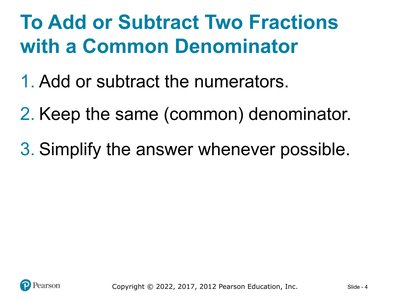
1. Add or subtract the numerators.
2. Keep the same (common) denominator.
3. Simplify the answer whenever possible.
The Least Common Denominator (LCD)
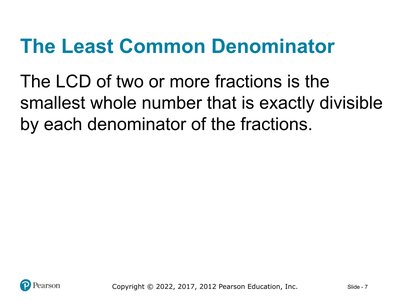
The Least Common Denominator (LCD) of two or more fractions is the smallest whole number that is exactly divisible by each denominator. Finding the LCD is necessary when adding or subtracting fractions with different denominators.
Key Point: The LCD allows fractions to be rewritten with a common denominator, making addition or subtraction possible.
Example: The LCD of and is 12, since 12 is the smallest number divisible by both 3 and 4.
Procedure to Find the LCD Using Prime Factors
Prime factorization is a systematic way to find the LCD of two or more denominators.
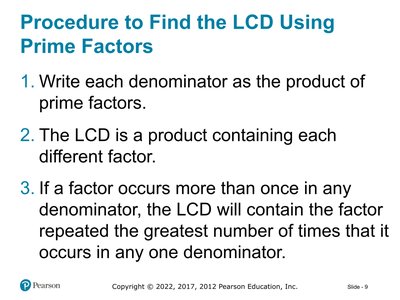
1. Write each denominator as the product of prime factors.
2. The LCD is a product containing each different factor.
3. If a factor occurs more than once in any denominator, the LCD will contain the factor repeated the greatest number of times that it occurs in any one denominator.
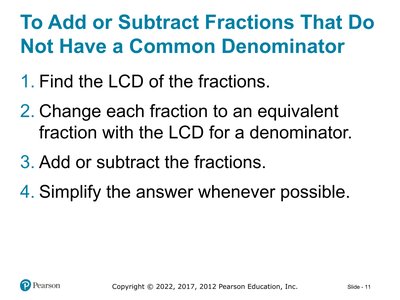
To Add or Subtract Fractions That Do Not Have a Common Denominator
When fractions have different denominators, follow these steps:
1. Find the LCD of the fractions.
2. Change each fraction to an equivalent fraction with the LCD as the denominator.
3. Add or subtract the fractions.
4. Simplify the answer whenever possible.
Adding or Subtracting Mixed Numbers
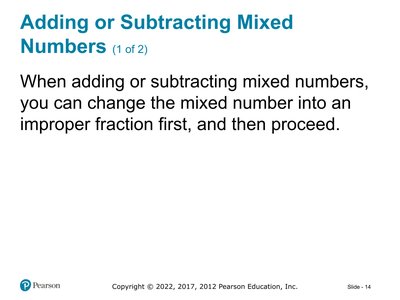
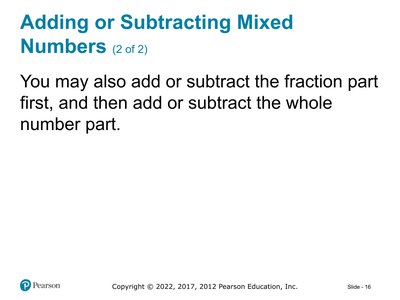
Mixed numbers consist of a whole number and a fraction. There are two main methods for adding or subtracting mixed numbers:
Method 1: Convert the mixed number to an improper fraction, then add or subtract as with regular fractions.
Method 2: Add or subtract the fractional parts first, then the whole number parts.
Example:
Additional info: Mastery of fraction operations is essential for solving equations, working with rational expressions, and understanding algebraic concepts in later chapters.
