 Back
BackSystems of Linear Equations: Graphing, Substitution, and Elimination
Study Guide - Smart Notes
 Tailored notes based on your materials, expanded with key definitions, examples, and context.
Systems of Linear Equations
Introduction to Systems of Linear Equations
A system of linear equations consists of two or more linear equations involving the same set of variables. The solution to a system is the set of values that satisfies all equations in the system simultaneously. In two variables, this solution corresponds to the point(s) where the graphs of the equations intersect.
System of Equations: A set of two or more equations with the same variables.
Solution: The point(s) (x, y) that satisfy all equations in the system.
Graphical Interpretation: The solution is the intersection point(s) of the lines represented by the equations.
Example: Determine if a given point is a solution to a system by substituting the values into each equation and checking if both are satisfied.
Solving Systems of Linear Equations by Graphing
Graphical Solution Method
To solve a system of linear equations by graphing, plot each equation on the same coordinate plane and identify the intersection point(s). This method is especially useful for visualizing the relationship between the equations.
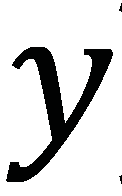
Write each equation in slope-intercept form: .
Graph each line on the same axes.
The intersection point(s) represent the solution(s) to the system.
Always check the solution by substituting the coordinates of the intersection into both equations.
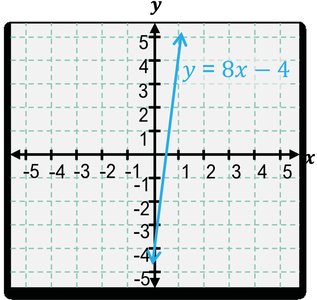
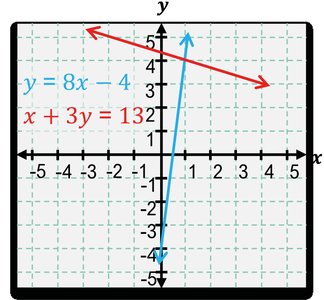
Example: Solve the system by graphing and identify the intersection point.
Types of Solutions for Systems of Linear Equations
There are three possible types of solutions for a system of two linear equations:
One Solution: The lines intersect at a single point (the system is consistent and independent).
No Solution: The lines are parallel and never intersect (the system is inconsistent).
Infinitely Many Solutions: The lines coincide (are the same line; the system is consistent and dependent).
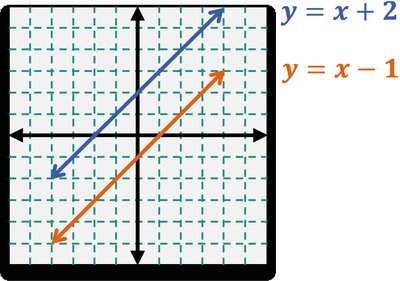
Practice: Identifying Solutions from Graphs
Use the graph to determine the number of solutions to a system. If there is a solution, verify that the intersection point satisfies both equations.
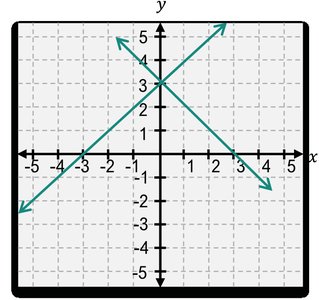
Matching Systems to Graphs
Given several systems and their graphs, match each system to its corresponding graph and solution type (one, none, or infinitely many solutions).
Determining the Number of Solutions Without Graphing
Using Slope-Intercept Form
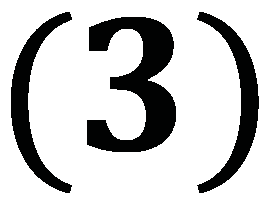
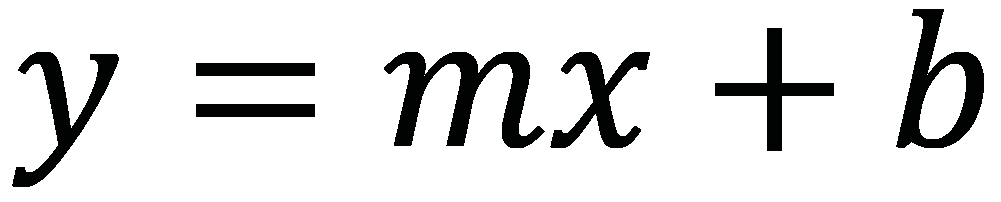
To determine the number of solutions algebraically, write both equations in slope-intercept form () and compare their slopes and y-intercepts:
If slopes are different, there is one solution.
If slopes are the same but y-intercepts are different, there are no solutions (parallel lines).
If both slopes and y-intercepts are the same, there are infinitely many solutions (same line).
Slopes | Y-Intercepts | Number of Solutions | System Type |
|---|---|---|---|
Different | Any | 1 | Consistent & Independent |
Same | Different | 0 | Inconsistent |
Same | Same | Infinitely Many | Consistent & Dependent |
Solving Systems of Linear Equations by Substitution
Substitution Method
The substitution method involves solving one equation for one variable and substituting this expression into the other equation. This method is especially useful when one equation is already solved for a variable.
Choose the easiest equation to isolate x or y.
Solve for that variable.
Substitute the expression into the other equation and solve for the remaining variable.
Plug the value back into either equation to find the other variable.
Check the solution in both equations.
Solving Systems of Linear Equations by Elimination
Elimination Method
The elimination method involves adding or subtracting equations to eliminate one variable, making it possible to solve for the other. This method is most effective when both equations are in standard form ().
Write both equations in standard form, aligning coefficients vertically.
Multiply one or both equations by a number so that the coefficients of one variable are equal and opposite in sign.
Add or subtract the equations to eliminate one variable.
Solve for the remaining variable.
Substitute back to find the other variable.
Check the solution in both equations.
How to Choose Multipliers:
Coefficient Relationship | What to Do |
|---|---|
Equal, Opposite Sign | Add equations |
Equal, Same Sign | Multiply one equation by -1 |
Factors of Each Other | Multiply smaller coefficient by quotient |
Anything Else | Multiply each equation by the other's coefficient (with appropriate sign) |
Choosing a Solution Method
When to Use Substitution or Elimination
Substitution: Use when one equation is already solved for a variable or has a coefficient of 1 or -1.
Elimination: Use when both equations are in standard form and coefficients are easily manipulated to eliminate a variable.
Example: For the system and , substitution is convenient. For and , elimination is more efficient.
Practice Problems and Classification
Classifying Systems
Without graphing, determine the number of solutions and classify the system as:
Independent and Consistent: One solution
Dependent and Consistent: Infinitely many solutions
Inconsistent: No solution
Summary Table: Types of Systems
Type | Number of Solutions | Graphical Representation |
|---|---|---|
Consistent & Independent | 1 | Intersecting lines |
Consistent & Dependent | Infinitely many | Coinciding lines |
Inconsistent | 0 | Parallel lines |
