Join thousands of students who trust us to help them ace their exams!
Multiple Choice
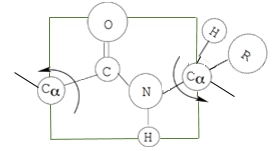
In the diagram below, the square plane drawn behind the protein molecule indicates the:
A
Plane of the peptide group due to absence of rotation & partial double-bond nature of the Cα-N bond.
B
Region of steric hindrance determined by the large C = O group.
C
Absence of rotation around the C-N bond because of its partial double-bond character.
D
Region of the peptide bond that contributes to a Ramachandran plot.
0 Comments
Verified step by step guidance
1
Identify the components of the peptide bond in the diagram: The peptide bond is formed between the carbon atom (C) of the carboxyl group and the nitrogen atom (N) of the amino group.
Understand the nature of the peptide bond: The peptide bond has partial double-bond character due to resonance, which restricts rotation around the C-N bond.
Recognize the significance of the square plane: The square plane in the diagram represents the plane of the peptide group, indicating the lack of rotation around the C-N bond due to its partial double-bond nature.
Consider the implications of the partial double-bond character: This characteristic contributes to the rigidity and planarity of the peptide bond, which is crucial for the secondary structure of proteins.
Relate the peptide bond to the Ramachandran plot: The Ramachandran plot is used to visualize the dihedral angles of amino acid residues in protein structure, which are influenced by the rigidity of the peptide bond.


 Verified step by step guidance

