Join thousands of students who trust us to help them ace their exams!
Multiple Choice
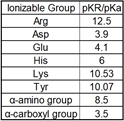
Use the chart to determine which tripeptide would elute last from an anion-exchange column at pH = 9.3.
A
Tyr-Lys-Met.
B
Gly-Pro-Arg.
C
Asp-Trp-Tyr.
D
Asp-His-Glu.
0 Comments
Verified step by step guidance
1
Understand that anion-exchange chromatography separates molecules based on their charge. At pH 9.3, molecules with a more negative charge will bind more strongly to the column and elute later.
Identify the ionizable groups in each tripeptide and their respective pKa values from the chart. For example, Asp (3.9), Glu (4.1), His (6), etc.
Calculate the net charge of each tripeptide at pH 9.3. Consider the ionization state of each ionizable group: if the pH is above the pKa, the group is deprotonated (negative for acidic groups, neutral for basic groups); if below, it is protonated (neutral for acidic groups, positive for basic groups).
For each tripeptide, sum the charges of the individual amino acids and the terminal groups (α-amino and α-carboxyl) to determine the overall charge at pH 9.3.
Compare the net charges: the tripeptide with the most negative net charge will elute last from the anion-exchange column. Based on the given answer, verify that Asp-His-Glu has the most negative charge at pH 9.3.


 Verified step by step guidance

