Join thousands of students who trust us to help them ace their exams!
Multiple Choice
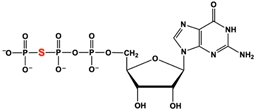
The addition of the nonhydrolyzable GTP-analog, GTPγS (shown below), is a common cell culture technique. If only affecting the inhibitory pathway, what effect would GTPγS have on cellular cAMP levels?
A
cAMP levels increase because adenylate cyclase can no longer hydrolyze GTP.
B
cAMP levels decrease because Gs remains in its inactive state and can no longer bind GDP.
C
cAMP levels decrease because Gi remains in its active state since it can no longer hydrolyze GTP.
D
cAMP levels increase because Gi remains in its inactive state since it can no longer hydrolyze GTP.
0 Comments
Verified step by step guidance
1
Understand the role of GTP in cellular signaling: GTP is a molecule that binds to G-proteins, which are involved in transmitting signals from outside the cell to the inside. When GTP is bound, the G-protein is active; when GDP is bound, it is inactive.
Identify the effect of GTPγS: GTPγS is a nonhydrolyzable analog of GTP, meaning it can bind to G-proteins but cannot be hydrolyzed to GDP. This means that G-proteins remain in their active state when bound to GTPγS.
Focus on the inhibitory pathway: In the context of the problem, we are interested in the inhibitory G-protein (Gi). Normally, Gi inhibits adenylate cyclase, reducing cAMP levels when active.
Analyze the effect of GTPγS on Gi: Since GTPγS cannot be hydrolyzed, Gi remains in its active state, continuously inhibiting adenylate cyclase. This leads to a decrease in cAMP levels because adenylate cyclase activity is reduced.
Conclude the effect on cAMP levels: With Gi remaining active due to the presence of GTPγS, cAMP levels decrease as adenylate cyclase is inhibited and cannot produce cAMP efficiently.


 Verified step by step guidance

