Join thousands of students who trust us to help them ace their exams!
Multiple Choice
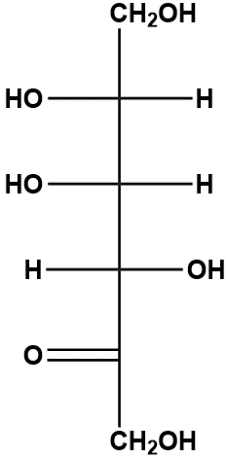
For monosaccharides to cyclize, an alcohol group must attack a carbonyl group within the same sugar. A) Which carbon of the linear ketohexose shown below has the reactive carbonyl? a) C1. b) C2. c) C3. d) C4. e) C5. B) Upon cyclization, would a hemiacetal or hemiketal form?
A
C1
B
C2
C
C3
D
C4
E
C5
0 Comments
Verified step by step guidance
1
Identify the structure of the linear ketohexose. A ketohexose is a six-carbon sugar with a ketone group. In the image, the ketone group is located at the second carbon (C2) from the top, which is characteristic of a ketose.
Determine which carbon has the reactive carbonyl group. In ketohexoses, the carbonyl group is typically at the C2 position. This is confirmed by the presence of the double-bonded oxygen (O) at C2 in the structure shown.
Understand the cyclization process. Cyclization occurs when an alcohol group within the sugar attacks the carbonyl carbon, forming a ring structure. In this case, the hydroxyl group on C5 will attack the carbonyl carbon at C2.
Determine the type of cyclic structure formed. When a ketone reacts with an alcohol, a hemiketal is formed. Since the carbonyl group is a ketone (at C2), the cyclization will result in a hemiketal.
Conclude the analysis. The reactive carbonyl carbon in the linear ketohexose is C2, and upon cyclization, a hemiketal is formed due to the reaction between the ketone group and an alcohol group within the molecule.


 Verified step by step guidance

