What types of molecules modify the rate of enzyme activity through allosteric regulation?
Allosteric effectors, which are small molecules that bind to allosteric sites on enzymes, modify the rate of enzyme activity.
What is an allosteric enzyme?
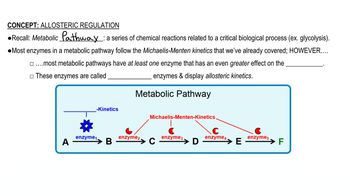
An allosteric enzyme is a complex enzyme with quaternary structure, composed of multiple polypeptide chains, that is regulated by allosteric effectors binding to specific allosteric sites distinct from the active site, allowing precise control of metabolic pathway kinetics.
What can cause an enzyme to change its shape in the context of allosteric regulation?
The binding of allosteric effectors to allosteric sites on an enzyme can cause the enzyme to change its shape, thereby modulating its activity.
How do allosteric enzymes differ structurally from typical Michaelis-Menten enzymes?
Allosteric enzymes usually have multiple polypeptide chains, giving them quaternary structure. In contrast, Michaelis-Menten enzymes typically have only one polypeptide chain.
What role do allosteric enzymes play in metabolic pathways?
Allosteric enzymes control key steps and have a major effect on the kinetics of the entire metabolic pathway. They monitor and regulate the flow of biochemicals more precisely than other enzymes.
Where do allosteric effectors bind on an allosteric enzyme?
Allosteric effectors bind to allosteric sites, which are distinct from the active sites on the enzyme. Each polypeptide chain in an allosteric enzyme has its own allosteric site.
Why are allosteric enzymes considered highly regulated compared to other enzymes?
Allosteric enzymes are highly regulated because they respond to allosteric effectors that modulate their activity. This regulation allows for precise control over metabolic pathway kinetics.
What is the significance of each polypeptide chain having its own active and allosteric site in allosteric enzymes?
Each polypeptide chain having its own active and allosteric site allows for multiple points of regulation and substrate binding. This contributes to the enzyme's complex control over metabolic reactions.
How does the presence of allosteric enzymes affect the overall speed of a metabolic pathway?
Allosteric enzymes can greatly influence the speed of a metabolic pathway by regulating key steps. Their activity can increase or decrease the pathway's overall rate depending on effector binding.
What is the primary function of allosteric regulation in cellular metabolism?
Allosteric regulation enables cells to efficiently respond to changing metabolic needs by modulating enzyme activity. This ensures proper control of biochemical flux in pathways like glycolysis.