How does an enzyme affect the activation energy and rate of a chemical reaction?
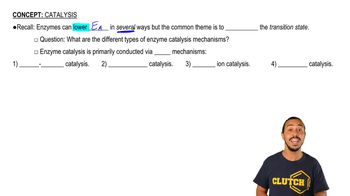
An enzyme lowers the activation energy of a chemical reaction by stabilizing the transition state and using mechanisms such as bringing substrates closer together, orienting them properly, distorting substrates, and desolvating substrates. This results in an increased reaction rate.
What happens to an enzyme after it catalyzes a reaction?
After catalyzing a reaction, an enzyme remains unchanged and can participate in additional rounds of catalysis with new substrate molecules.
What occurs during the process when an enzyme catalyzes a reaction?
When an enzyme catalyzes a reaction, it lowers the activation energy by stabilizing the transition state and facilitating mechanisms such as acid-base catalysis, electrostatic catalysis, metal ion catalysis, or covalent catalysis, leading to a faster conversion of substrates to products.
Can an enzyme be used more than once in catalyzing reactions?
Yes, enzymes are not consumed in the reactions they catalyze and can be used repeatedly to catalyze the same reaction with multiple substrate molecules.
What is the main difference between specific acid-base catalysis and general acid-base catalysis?
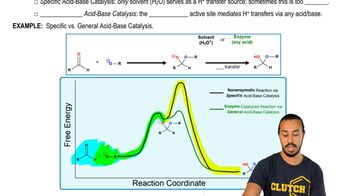
Specific acid-base catalysis uses only the solvent as the proton transfer source, while general acid-base catalysis can use any acid or base with the enzyme's active site mediating the transfer. This makes general acid-base catalysis faster and more versatile.
Why is the charged intermediate in the example reaction considered unstable?
The charged intermediate is unstable because its free energy is higher than that of the reactants or products. This instability favors the reverse reaction unless the activation energy for the forward reaction is lowered.
How does general acid-base catalysis affect the activation energy of a reaction compared to specific acid-base catalysis?
General acid-base catalysis lowers the activation energy more effectively than specific acid-base catalysis. This results in a faster formation of the product.
What role does the enzyme's active site play in general acid-base catalysis?
The enzyme's active site mediates the proton transfer during general acid-base catalysis. This involvement accelerates the reaction and reduces the activation energy.
In biological systems, which molecule typically acts as the proton transfer source in specific acid-base catalysis?
Water is usually the proton transfer source in specific acid-base catalysis within biological systems. It can donate protons through its autoionization to form hydronium ions.
Why does the forward reaction in the example proceed slowly without enzyme catalysis?
Without enzyme catalysis, the activation energy for the forward reaction is high, making the process slow. This causes the intermediate to revert to reactants rather than forming the product efficiently.