Back

Enzyme-Substrate Complex definitions

Control buttons has been changed to "navigation" mode.
1/15
  • Enzyme-Substrate Complex

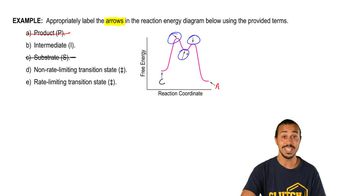
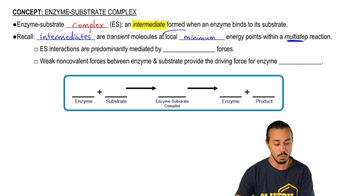
    Intermediate formed when an enzyme binds to its substrate, appearing at a local minimum energy point in a reaction.
  • Intermediate

    Transient molecule in a multi-step reaction, existing briefly at a local minimum energy point before further transformation.
  • Transition State

    High-energy configuration in a reaction, represented by a local maximum peak on an energy diagram.
  • Activation Energy

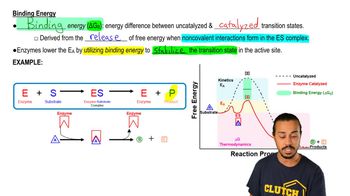
    Energy barrier that must be overcome for a reaction to proceed, lowered by enzyme stabilization of the transition state.
  • Non Covalent Forces

    Weak interactions, such as hydrogen and ionic bonds, that mediate most enzyme-substrate complex formation.
  • Hydrogen Bond

    Type of non covalent interaction contributing to the stabilization of enzyme-substrate complexes.
  • Ionic Bond

    Electrostatic attraction between charged groups, often involved in enzyme-substrate complex stabilization.
  • Catalysis

    Process by which enzymes accelerate chemical reactions, primarily through stabilization of the transition state.
  • Binding Energy

    Energy released when non covalent interactions form in the enzyme-substrate complex, used to stabilize the transition state.
  • Active Site

    Region of an enzyme where substrate binding and transition state stabilization occur.
  • Product

    Molecule generated from substrate transformation during an enzyme-catalyzed reaction.
  • Substrate

    Molecule that interacts with an enzyme, forming a complex and undergoing conversion to a product.
  • Energy Diagram

    Graphical representation of energy changes during a reaction, illustrating intermediates and transition states.
  • Uncatalyzed Reaction

    Chemical process occurring without enzyme involvement, characterized by a higher activation energy.
  • Catalyzed Reaction

    Chemical process facilitated by an enzyme, resulting in a lower activation energy and faster product formation.