Pearson+ LogoPearson+ Logo

G protein-Coupled Receptors quiz #1 Flashcards

Back
G protein-Coupled Receptors quiz #1
Control buttons has been changed to "navigation" mode.
1/10
  • What cellular events can be triggered by an activated G protein in the G protein-coupled receptor (GPCR) pathway?

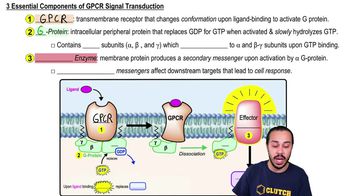
    An activated G protein can interact with and activate or inhibit an effector enzyme, leading to the production or reduction of secondary messengers, which then initiate downstream cellular responses.
  • What structural feature distinguishes GPCRs from other membrane proteins?

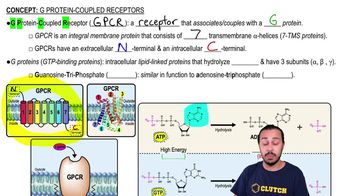
    GPCRs have seven transmembrane alpha helices, making them unique among membrane proteins. This structure is sometimes referred to as 7 TMS.
  • Where are the N-terminal and C-terminal domains of a GPCR located relative to the cell membrane?

    The N-terminal domain of a GPCR is extracellular, while the C-terminal domain is intracellular. This orientation is important for receptor function.
  • What is the role of ligand binding in the activation of a GPCR?

    Ligand binding induces a conformational change in the GPCR. This change is necessary to activate the associated G protein.
  • How does the G protein switch between its active and inactive states?

    The G protein is inactive when bound to GDP and becomes active when GDP is replaced by GTP. Hydrolysis of GTP back to GDP returns it to the inactive state.
  • What happens to the subunits of a heterotrimeric G protein upon activation?

    Upon activation, the alpha subunit dissociates from the beta and gamma subunits. The alpha subunit then interacts with the effector enzyme.
  • What is the function of the effector enzyme in the GPCR pathway?

    The effector enzyme produces secondary messengers when activated by the G protein's alpha subunit. These secondary messengers initiate downstream cellular responses.
  • How do stimulatory (Gs) and inhibitory (Gi) G proteins differ in their effect on the effector enzyme?

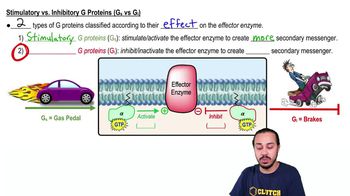
    Stimulatory G proteins (Gs) activate the effector enzyme to increase secondary messenger production. Inhibitory G proteins (Gi) inhibit the effector enzyme, reducing secondary messenger production.
  • What analogy is used to describe the actions of Gs and Gi proteins in the video?

    Gs proteins are compared to a car's gas pedal, accelerating secondary messenger production. Gi proteins are likened to brakes, slowing down secondary messenger production.
  • What type of molecule is GTP, and how does it compare to ATP in function?

    GTP is a high-energy molecule similar in function to ATP. Both serve as energy sources, but GTP is specifically used by G proteins for activation.