What is the definition of a protein-binding site in the context of protein-ligand interactions?
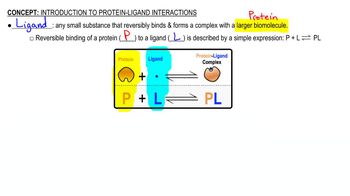
A protein-binding site is a specific region on a protein where a ligand, which is a small molecule, can reversibly bind to form a protein-ligand complex.
How are proteins and ligands typically represented in notation for protein-ligand interactions?
Proteins are represented by the capital letter P and ligands by the capital letter L. The protein-ligand complex is abbreviated as PL.
What do the equilibrium arrows in the protein-ligand interaction equation indicate?
The equilibrium arrows show that the binding between protein and ligand is reversible. This means the complex can dissociate back into free protein and ligand.
How do protein-ligand interactions differ from enzyme-substrate interactions?
Protein-ligand interactions do not result in the conversion of the ligand into a product. In contrast, enzyme-substrate interactions involve the enzyme catalyzing a reaction that transforms the substrate into a product.
What is the association rate constant in protein-ligand interactions and how is it abbreviated?
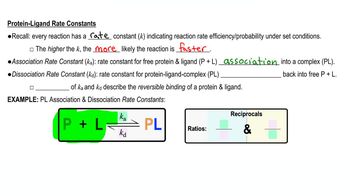
The association rate constant describes the rate at which free protein and ligand form the protein-ligand complex. It is abbreviated as k_a, where 'a' stands for association.
What does the dissociation rate constant represent in protein-ligand interactions?
The dissociation rate constant represents the rate at which the protein-ligand complex breaks down into free protein and ligand. It is abbreviated as k_d, with 'd' standing for dissociation.
Why are the ratios of k_a and k_d important in studying protein-ligand binding?
The ratios of k_a and k_d help describe the reversible nature of protein-ligand binding. These ratios are crucial for understanding how tightly a ligand binds to a protein.
What is the reciprocal relationship between the two key rate constant ratios in protein-ligand interactions?
The two key ratios are k_a/k_d and k_d/k_a, which are reciprocals of each other. These ratios provide different perspectives on the binding and dissociation processes.
What does the lowercase 'k' in k_a and k_d indicate in the context of rate constants?
The lowercase 'k' indicates that these are rate constants related to reaction rates. This is distinct from the uppercase 'K' used for equilibrium constants, which will be discussed later.
Why should students be careful not to confuse the 'P' used for protein with the 'P' used for product in biochemistry notation?
In protein-ligand interactions, 'P' stands for protein, while in enzyme-substrate reactions, 'P' can refer to product. Mixing these up could lead to misunderstanding the reaction being described.