What is the final electron acceptor in the electron transport chain (ETC) during oxidative phosphorylation?
The final electron acceptor in the electron transport chain is molecular oxygen (O2).
What are the main products generated by the electron transport chain (ETC) in oxidative phosphorylation?
The main products of the electron transport chain are ATP, water (H2O), and regenerated NAD+ and FAD.
Which two processes are coupled throughout the electron transport chain (ETC) in oxidative phosphorylation?
Electron transport and proton pumping (generation of a protonmotive force) are coupled throughout the electron transport chain.
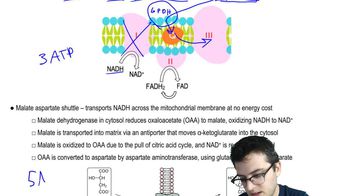
How does the malate-aspartate shuttle contribute to ATP production during oxidative phosphorylation?
The malate-aspartate shuttle transfers electrons from cytosolic NADH into the mitochondrial matrix without energy cost, allowing the electrons to enter the electron transport chain and ultimately yield 5 ATP per NADH.
Which enzyme is responsible for transferring electrons from cytosolic NADH to FAD in the glycerol 3-phosphate shuttle?
Glycerol 3-phosphate dehydrogenase transfers electrons from cytosolic NADH to FAD, forming FADH2. This process bypasses complex I in the electron transport chain.
What molecule is reduced by NADH during the initial step of the glycerol 3-phosphate shuttle?
Dihydroxyacetone phosphate (DHAP) is reduced by NADH to form glycerol 3-phosphate. This reaction occurs in the cytosol before electrons are transferred into the mitochondria.
How does the malate-aspartate shuttle use antiporters to facilitate electron transfer into the mitochondrial matrix?
The malate-aspartate shuttle uses an antiporter to exchange malate into the matrix for α-ketoglutarate out to the cytosol. Another antiporter exchanges aspartate out of the matrix for glutamate in.
What role does glutamate play in the conversion of oxaloacetate to aspartate within the mitochondrial matrix?
Glutamate donates its amino group to oxaloacetate, converting it into aspartate. This reaction also produces α-ketoglutarate as a byproduct.
How is aspartate converted back to oxaloacetate in the cytosol during the malate-aspartate shuttle cycle?
Aspartate is converted back to oxaloacetate by transferring its amino group to α-ketoglutarate, reforming glutamate. This completes the cycle and allows the shuttle to continue.
Why does the glycerol 3-phosphate shuttle yield fewer ATP per NADH compared to the malate-aspartate shuttle?
The glycerol 3-phosphate shuttle bypasses complex I, resulting in fewer protons pumped and less ATP generated. In contrast, the malate-aspartate shuttle allows electrons to enter at complex I, maximizing ATP yield.