Pearson+ LogoPearson+ Logo

Peptidases quiz #1 Flashcards

Back
Peptidases quiz #1
Control buttons has been changed to "navigation" mode.
1/10
  • Where does protein digestion begin in the human digestive system?

    Protein digestion begins in the stomach.
  • Which enzyme is primarily responsible for breaking down proteins in the stomach?

    Pepsin is the enzyme that breaks down proteins in the stomach.
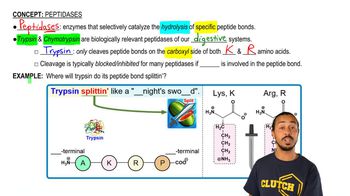
  • What is the general role of peptidases in protein digestion?

    Peptidases are enzymes that catalyze the hydrolysis of specific peptide bonds, breaking down proteins into smaller peptide fragments.
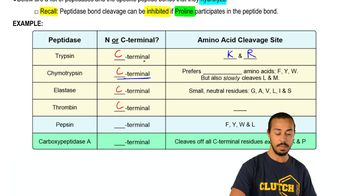
  • Which peptidase cleaves peptide bonds on the N-terminal side of aromatic amino acids and leucine during protein digestion?

    Pepsin cleaves peptide bonds on the N-terminal side of aromatic amino acids (phenylalanine, tyrosine, tryptophan) and leucine.
  • How does proline affect the cleavage of peptide bonds by peptidases?

    Proline inhibits the cleavage of peptide bonds by peptidases when it is involved in the bond, blocking enzymatic hydrolysis.
  • What mnemonic can help you remember the amino acid residues that trypsin cleaves after?

    The mnemonic 'dragons eat knights riding horses' helps recall that trypsin cleaves after lysine (K) and arginine (R). K and R represent the residues recognized by trypsin.
  • Which peptidase cleaves peptide bonds on the carboxyl side of small neutral R group amino acids, excluding methionine and proline?

    Elastase cleaves on the carboxyl side of small neutral R group amino acids, but does not cleave methionine or proline. It also recognizes serine for cleavage.
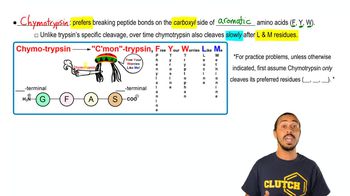
  • How does chymotrypsin's specificity for amino acid residues differ from trypsin's?

    Chymotrypsin prefers aromatic residues (phenylalanine, tyrosine, tryptophan) and can slowly cleave leucine and methionine, while trypsin only cleaves after lysine and arginine. Both cleave on the carboxyl side of their recognized residues.
  • Which peptidase only cleaves after arginine and not lysine, and on which side of the residue does it cleave?

    Thrombin only cleaves after arginine and not lysine. It cleaves on the carboxyl side of the arginine residue.
  • What is unique about carboxypeptidase A's cleavage specificity compared to other peptidases discussed?

    Carboxypeptidase A cleaves only C-terminal residues but does not cleave arginine, lysine, or proline. It removes the terminal amino acid by cleaving the N-terminal bond of the C-terminal residue.