What is the role of enzymes in biochemical reactions?
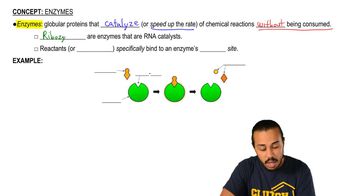
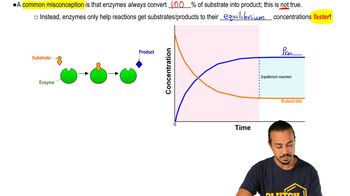
Enzymes speed up reactions by lowering the activation energy through substrate binding and catalysis.
Describe the Michaelis-Menten equation.
Initial velocity vi = (Vmax [S]) / (Km + [S]), where Vmax is max velocity, Km is substrate concentration at half Vmax, and [S] is substrate concentration.
What does a low Km indicate about enzyme affinity?
A low Km indicates high substrate affinity, meaning the enzyme reaches half-max velocity at low substrate concentration.
Explain the Lineweaver-Burk plot and its significance.
A double-reciprocal plot of 1/vi vs 1/[S] used to determine Km and Vmax from the y-intercept (1/Vmax) and x-intercept (-1/Km).
What is the difference between hyperbolic and sigmoidal substrate saturation kinetics?
Hyperbolic kinetics show simple saturation; sigmoidal kinetics indicate cooperative binding among enzyme subunits.
How does competitive inhibition affect enzyme kinetics?
Competitive inhibitors bind the active site, increasing apparent Km but not changing Vmax; inhibition can be overcome by high substrate.
How does noncompetitive inhibition affect enzyme kinetics?
Noncompetitive inhibitors bind allosteric sites, decreasing Vmax without changing Km; inhibition cannot be overcome by substrate.
What is feedback inhibition in metabolic pathways?
End products inhibit enzymes earlier in the pathway to regulate metabolite flow and prevent overproduction.
Describe covalent modification of enzymes by phosphorylation.
Kinases add phosphate groups to serine residues, altering enzyme activity; phosphatases remove them, reversing the effect.
What is the first law of thermodynamics in biological systems?
Energy is conserved; it is transferred or transformed but not created or destroyed.
Define entropy and enthalpy in biochemical reactions.
Entropy is system disorder; enthalpy is total heat content. Spontaneous reactions increase entropy and may release or absorb heat.
What does a negative ΔG indicate about a reaction?
A negative ΔG means the reaction is exergonic and proceeds spontaneously, releasing free energy.
How is ATP used as an energy currency in cells?
ATP stores energy in high-energy phosphate bonds and transfers it to drive endergonic reactions.
What is the role of the mitochondrial electron transport chain (ETC)?
ETC transfers electrons from NADH/FADH2 to oxygen, pumping protons to create a gradient used for ATP synthesis.
Which ETC complexes pump protons and which do not?
Complexes I, III, and IV pump protons; Complex II does not pump protons but transfers electrons from FADH2.
Explain the Q cycle in Complex III of the ETC.
Q cycle splits two electrons from ubiquinol; one reduces cytochrome c, the other recycles ubiquinone, enhancing proton pumping.
What is the chemiosmotic theory?
Electron transport pumps protons creating a gradient; ATP synthase uses proton flow back into the matrix to synthesize ATP.
How do uncouplers affect oxidative phosphorylation?
Uncouplers dissipate the proton gradient, allowing electron transport without ATP synthesis, releasing energy as heat.
Describe the glycerol 3-phosphate shuttle.
Transfers reducing equivalents from cytosolic NADH to mitochondrial FAD via glycerol 3-phosphate dehydrogenase.
Describe the malate-aspartate shuttle.
Transfers reducing equivalents by converting oxaloacetate to malate in cytosol, transporting it into mitochondria, then back to oxaloacetate.
 Back
Back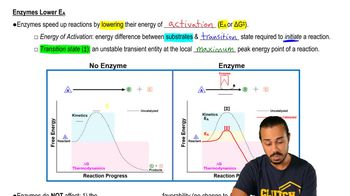
 04:59
04:59