What family of organic compounds does a molecule with only carbon and hydrogen atoms and one carbon–carbon double bond belong to?
It is an alkene, a type of hydrocarbon with at least one carbon–carbon double bond.
How is an alcohol identified in organic compounds?
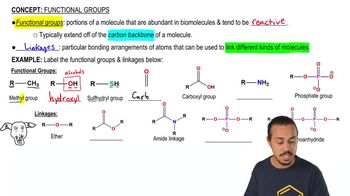
An alcohol contains an oxygen atom with a single bond to a hydrogen atom (–OH group) bonded to a tetravalent carbon.
What defines an aromatic hydrocarbon compound?
A six-membered ring with alternating carbon–carbon single and double bonds, often called a benzene ring, defines an aromatic hydrocarbon.
How is a ketone functional group characterized?
A ketone has a carbon–oxygen double bond (carbonyl) connected to two carbon atoms, with no singly bonded oxygen or nitrogen attached to the carbonyl carbon.
What functional groups are present in a molecule with both an amide and an amine?
An amide group has a carbonyl bonded to an –NH2, and an amine group contains an –NH2 not bonded to a carbonyl.
What functional groups are indicated by a ring with alternating single and double bonds and an S–S bond?
The ring is an aromatic hydrocarbon, and the S–S bond indicates a disulfide group.
What is the general formula and structure of an amine with formula C2H7N?
An amine contains a C–NH2 group; for C2H7N, two carbons are bonded together with an –NH2 attached to one carbon and hydrogens filling remaining bonds.
What characterizes an alkyne with formula C3H4?
An alkyne contains a carbon–carbon triple bond; for C3H4, two carbons form a triple bond, and the third carbon is bonded to one of these with hydrogens filling remaining bonds.
What is the structure of an ether with formula C4H10O?
An ether contains a C–O–C group; for C4H10O, two carbons are bonded on either side of oxygen, with remaining hydrogens filling carbon valences.
Which characteristics are typical of organic compounds?
Organic compounds typically have low melting points, are not soluble in water, burn easily in air, and have covalent bonds.
Which of the following contains only organic compounds: CH3OH, H2SO4, KCl; C4H10, CH3COOH, CH3OH; KCl, C4H10, CH3COOH; or CH3CH2CH2Cl, KCl, NaCl?
Only C4H10, CH3COOH, CH3OH contains exclusively organic compounds.
What is the physical state of octane (C8H18) at room temperature?
Octane is most likely a liquid at room temperature.
What are the products of octane combustion?
Complete combustion of octane produces CO2 and H2O.
Which property is NOT typical of hydrocarbons?
Hydrocarbons are generally nonpolar, so being polar is not typical.
What is the product of the hydration reaction of an alkene with water in the presence of acid?
The product is an alcohol.
How can you identify if two structures with formula C7H16 represent the same molecule?
Check the longest carbon chain and the position of branches; identical chains and branch positions indicate the same molecule (conformers).
What is the primary difference between isomers and conformers?
Isomers have different connectivity of atoms; conformers differ only by rotation around single bonds.
How do you convert a condensed structure to a line structure?
Draw a zigzag line representing the longest carbon chain; add branches as lines off the main chain; show all non-carbon atoms explicitly.
What type of reaction is hydrogenation of an alkene?
Hydrogenation is an addition reaction where H2 adds across the double bond.
What is the role of water in the reaction of ammonia with water?
Water acts as an acid donating a hydrogen ion to ammonia, which acts as a base.
How is an ester formed from a carboxylic acid and an alcohol?
By removing –OH from the acid and –H from the alcohol to form water, then joining the remaining fragments with a single bond.
What are the products of acid-catalyzed hydrolysis of an ester like ethyl formate?
The products are a carboxylic acid and an alcohol.
How do you classify amino acids as polar or nonpolar?
Amino acids with nonpolar side chains (e.g., glycine) are nonpolar; those with polar side chains (e.g., threonine) are polar.
What stabilizes the alpha helix and beta-pleated sheet secondary protein structures?
Hydrogen bonds between backbone nitrogen and carbonyl oxygen atoms stabilize secondary structures.
What types of interactions stabilize tertiary protein structure?
Tertiary structure is stabilized by hydrophobic interactions, disulfide bonds, ionic bonds, and hydrogen bonds between R groups.
What is the difference between primary, secondary, tertiary, and quaternary protein structures?
Primary is amino acid sequence; secondary is local folding (alpha helix, beta sheet); tertiary is 3D folding of one chain; quaternary is assembly of multiple chains.
What effect do pH and temperature changes have on enzyme activity?
Deviations from optimum pH or temperature generally decrease enzyme activity.
How do competitive and noncompetitive enzyme inhibitors differ?
Competitive inhibitors bind the active site and can be overcome by more substrate; noncompetitive bind elsewhere and cannot be overcome by substrate.
 Back
Back
 03:24
03:24