
Pearson+ LogoPearson+ Logo
Ch. 15 - DNA and the Gene: Synthesis and Repair
Freeman - Biological Science 7th Edition
Freeman7th EditionBiological ScienceISBN: 9783584863285Not the one you use?Change textbook
Chapter 15, Problem 1

Which of the following is not a property of DNA polymerase?
a. It adds dNTPs only in the 5'→3' direction.
b. It requires a primer to begin synthesis.
c. It opens the two strands of DNA at the replication fork.
d. Its exonuclease activity is involved in proofreading.

Verified step by step guidance
1
Understand the role of DNA polymerase in DNA replication. DNA polymerase is an enzyme responsible for synthesizing new DNA strands by adding nucleotides to a pre-existing chain.
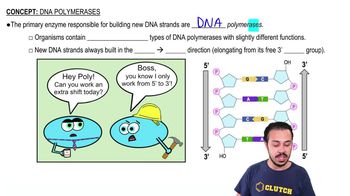
Review the properties of DNA polymerase: It adds deoxynucleotide triphosphates (dNTPs) to the growing DNA strand in the 5' to 3' direction, meaning it can only add nucleotides to the 3' end of the DNA strand.
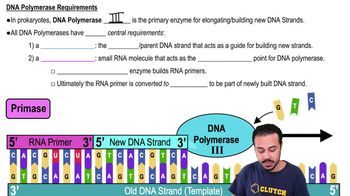
Recognize that DNA polymerase requires a primer to begin synthesis. A primer is a short nucleic acid sequence that provides a starting point for DNA synthesis.
Consider the role of DNA polymerase in proofreading. DNA polymerase has exonuclease activity that allows it to remove incorrectly paired nucleotides, ensuring the accuracy of DNA replication.
Identify the incorrect statement: DNA polymerase does not open the two strands of DNA at the replication fork. This function is performed by helicase, another enzyme involved in DNA replication.

Verified video answer for a similar problem:

This video solution was recommended by our tutors as helpful for the problem above.
Video duration:
1m
Was this helpful?

Key Concepts

Here are the essential concepts you must grasp in order to answer the question correctly.

DNA Polymerase Function

DNA polymerase is an enzyme responsible for synthesizing new DNA strands by adding deoxyribonucleotide triphosphates (dNTPs) to a growing DNA chain. It operates exclusively in the 5' to 3' direction, meaning it adds nucleotides to the 3' end of the DNA strand. This directional activity is crucial for accurate DNA replication.
Recommended video:
Guided course
04:01
DNA Polymerases

Primer Requirement

DNA polymerase requires a primer to initiate DNA synthesis. A primer is a short nucleic acid sequence that provides a starting point for DNA synthesis. Without a primer, DNA polymerase cannot begin adding nucleotides, as it needs a free 3' hydroxyl group to attach the first dNTP.
Recommended video:
Guided course
05:03
DNA Polymerase Requirements

Exonuclease Activity

Exonuclease activity refers to the ability of DNA polymerase to remove nucleotides from the ends of DNA strands. This activity is crucial for proofreading, allowing the enzyme to correct errors by excising mismatched bases during DNA replication. It ensures high fidelity in DNA synthesis by reducing the rate of mutations.
Recommended video:
Guided course
02:37
Active Transport