
Pearson+ LogoPearson+ Logo
Ch. 15 - DNA and the Gene: Synthesis and Repair
Freeman - Biological Science 7th Edition
Freeman7th EditionBiological ScienceISBN: 9783584863285Not the one you use?Change textbook
Chapter 15, Problem 3

How are Okazaki fragments synthesized?
a. By using the leading-strand template, and synthesizing 5'→3'
b. By using the leading-strand template, and synthesizing 3'→5'
c. By using the lagging-strand template, and synthesizing 5'→3'
d. By using the lagging-strand template, and synthesizing 3'→5'.

Verified step by step guidance
1
Understand that DNA replication involves the synthesis of new DNA strands using existing strands as templates. The two strands of DNA are antiparallel, meaning they run in opposite directions.
Recognize that DNA polymerase, the enzyme responsible for synthesizing new DNA, can only add nucleotides in the 5' to 3' direction. This is a key constraint in DNA replication.
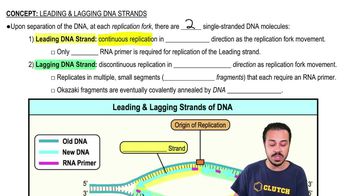
Identify that the leading strand is synthesized continuously in the 5' to 3' direction as the replication fork opens. In contrast, the lagging strand is synthesized discontinuously.
Learn that Okazaki fragments are short sequences of DNA nucleotides synthesized discontinuously on the lagging strand. These fragments are later joined together by the enzyme DNA ligase.
Conclude that Okazaki fragments are synthesized using the lagging-strand template in the 5' to 3' direction, which corresponds to option c.

Verified video answer for a similar problem:

This video solution was recommended by our tutors as helpful for the problem above.
Video duration:
1m
Was this helpful?

Key Concepts

Here are the essential concepts you must grasp in order to answer the question correctly.

DNA Replication

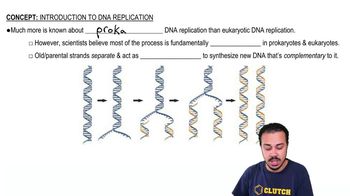
DNA replication is the process by which a cell duplicates its DNA, ensuring that each daughter cell receives an exact copy of the genetic material. It involves unwinding the double helix and synthesizing new strands using the original strands as templates. This process is crucial for cell division and is highly regulated to maintain genetic fidelity.
Recommended video:
Guided course
03:37
Introduction to DNA Replication

Leading and Lagging Strands

During DNA replication, the two strands of the double helix are replicated differently due to their antiparallel nature. The leading strand is synthesized continuously in the 5' to 3' direction, while the lagging strand is synthesized discontinuously in short segments called Okazaki fragments, also in the 5' to 3' direction, due to the opposite orientation.
Recommended video:
Guided course
05:15
Leading & Lagging DNA Strands

Okazaki Fragments

Okazaki fragments are short sequences of DNA nucleotides synthesized on the lagging strand during DNA replication. These fragments are created because DNA polymerase can only synthesize DNA in the 5' to 3' direction, necessitating a discontinuous approach on the lagging strand. They are later joined by DNA ligase to form a continuous strand.
Recommended video:
Guided course
05:15
Leading & Lagging DNA Strands