 Back
BackA Tour of the Cell: Structure and Function of Eukaryotic Cells
Study Guide - Smart Notes
 Tailored notes based on your materials, expanded with key definitions, examples, and context.
Concept 6.1: Biologists Use Microscopes and Biochemistry to Study Cells
Microscopy and Cell Fractionation
Advances in microscopy and biochemistry have been crucial for understanding cell structure and function. Microscopes allow scientists to visualize cells and their components, while biochemical techniques enable the isolation and analysis of specific cellular parts.
Light Microscopy (LM): Uses visible light to observe living or fixed cells. Limited by resolution (~200 nm).
Electron Microscopy (EM): Uses electron beams for much higher resolution, revealing ultrastructure of cells.
Cell Fractionation: Involves centrifuging disrupted cells at various speeds to separate cellular components, allowing for biochemical analysis of organelles.
Key Point: Microscopy provides visual context, while biochemistry reveals molecular composition and function, together offering a comprehensive understanding of cells.
Concept 6.2: Eukaryotic Cells Have Internal Membranes That Compartmentalize Their Functions
Prokaryotic vs. Eukaryotic Cells
All cells are surrounded by a plasma membrane. Prokaryotic cells lack a nucleus and membrane-bound organelles, while eukaryotic cells possess internal membranes that compartmentalize cellular functions.
Surface-to-Volume Ratio: Limits cell size; smaller cells have a greater ratio, facilitating efficient exchange of materials.
Common Organelles: Both plant and animal cells contain a nucleus, endoplasmic reticulum, Golgi apparatus, and mitochondria. Chloroplasts are unique to photosynthetic eukaryotes.
Key Point: Compartmentalization allows for specialized environments and processes within the cell, increasing efficiency and complexity.
Concept 6.3: The Eukaryotic Cell’s Genetic Instructions Are Housed in the Nucleus and Carried Out by the Ribosomes
Nucleus and Ribosomes
The nucleus contains most of the cell’s genetic material and coordinates activities such as growth and reproduction. Ribosomes are the sites of protein synthesis, translating genetic instructions into functional proteins.
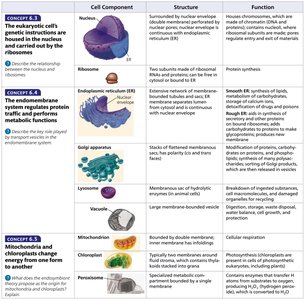
Cell Component | Structure | Function |
|---|---|---|
Nucleus | Surrounded by double membrane (nuclear envelope) with pores; contains nucleolus and chromatin | Houses chromosomes (DNA); nucleolus produces ribosomes; pores regulate entry/exit of materials |
Ribosome | Two subunits made of rRNA and proteins; can be free in cytosol or bound to ER | Protein synthesis (translation of mRNA) |
Concept 6.4: The Endomembrane System Regulates Protein Traffic and Performs Metabolic Functions
Endoplasmic Reticulum (ER), Golgi Apparatus, Lysosomes, and Vacuoles
The endomembrane system includes the nuclear envelope, ER, Golgi apparatus, lysosomes, and vacuoles. These organelles work together to synthesize, modify, sort, and transport proteins and lipids.
Rough ER: Studded with ribosomes; synthesizes proteins for secretion or membrane insertion.
Smooth ER: Lacks ribosomes; synthesizes lipids, metabolizes carbohydrates, detoxifies drugs, and stores calcium ions.
Golgi Apparatus: Modifies, sorts, and packages proteins and lipids for storage or transport out of the cell.
Lysosomes: Contain hydrolytic enzymes for intracellular digestion of macromolecules.
Vacuoles: Diverse functions including storage, waste disposal, and maintaining cell turgor in plants.
Example: Secretory proteins are synthesized in the rough ER, modified in the Golgi, and transported in vesicles to the plasma membrane for exocytosis.
Concept 6.5: Mitochondria and Chloroplasts Change Energy from One Form to Another
Energy-Transforming Organelles
Mitochondria and chloroplasts are the main energy-transforming organelles in eukaryotic cells. Mitochondria are the sites of cellular respiration, generating ATP from organic fuels. Chloroplasts, found in plants and algae, convert solar energy into chemical energy via photosynthesis.
Mitochondria: Double-membraned; inner membrane folded into cristae; contains its own DNA and ribosomes.
Chloroplasts: Double-membraned; contains thylakoids stacked into grana; also contains DNA and ribosomes.
Peroxisomes: Single-membraned; contain enzymes that transfer hydrogen from substrates to oxygen, producing hydrogen peroxide, which is then converted to water.
Key Point: These organelles are essential for energy conversion and have features suggesting an evolutionary origin from endosymbiotic prokaryotes.
Concept 6.6: The Cytoskeleton Is a Network of Fibers That Organizes Structures and Activities in the Cell
Cytoskeletal Elements and Their Functions
The cytoskeleton is a dynamic network of protein fibers that provides structural support, facilitates cell movement, and organizes cellular activities.
Microtubules: Hollow rods that shape the cell, guide organelle movement, and separate chromosomes during cell division. Also form the core of cilia and flagella.
Microfilaments (Actin Filaments): Thin rods involved in muscle contraction, cell movement, and maintaining cell shape.
Intermediate Filaments: Provide mechanical support and anchor organelles in place.
Motor Proteins: Interact with cytoskeletal elements to produce cell movement and transport vesicles within the cell.
Concept 6.7: Extracellular Components and Connections Between Cells Help Coordinate Cellular Activities
Cell Walls, Extracellular Matrix, and Cell Junctions
Cells interact with their environment and each other through extracellular structures and junctions.
Plant Cell Walls: Composed mainly of cellulose, provide structural support and protection.
Extracellular Matrix (ECM) in Animals: Made of glycoproteins and proteoglycans; supports, anchors, and regulates cells.
Cell Junctions: Plasmodesmata in plants allow communication between cells. Animal cells have tight junctions (prevent leakage), desmosomes (anchor cells), and gap junctions (allow exchange of materials).
Comparison: Both plant cell walls and animal ECM provide structural support, but differ in composition and additional functions such as signaling and adhesion.
Concept 6.8: A Cell Is Greater Than the Sum of Its Parts
Integration of Cellular Components
Cellular function arises from the coordinated activity of many components. For example, when a cell ingests a bacterium, the nucleus directs the synthesis of enzymes and proteins needed for digestion and defense.
Emergent Properties: The whole cell exhibits properties and functions not evident from individual parts alone.
Key Point: Understanding cells requires integrating knowledge of all their structures and processes.
