 Back
BackAnimal Diversity II: Basal Animals – Porifera and Cnidaria
Study Guide - Smart Notes
 Tailored notes based on your materials, expanded with key definitions, examples, and context.
Animal Diversity II: Basal Animals
Introduction to Basal Animal Diversity
Basal animals represent some of the earliest diverging lineages in the animal kingdom. This section focuses on two major phyla: Porifera (sponges) and Cnidaria (jellyfish, corals, sea anemones). Understanding their features, classification, and evolutionary significance provides insight into the origins and diversification of animal life.
Phylum Porifera (Sponges)
General Characteristics of Sponges
Sponges are the most basal lineage of animals, closely related to choanoflagellate protists.
They are multicellular but lack true tissues and organs.
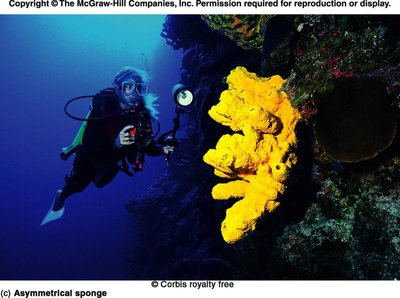
Sponges are primarily asymmetrical and are found mostly in marine environments.
They possess a simple body plan composed of three main components:
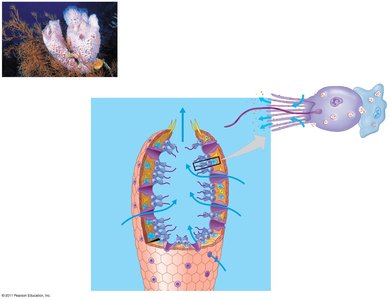
Cells: Specialized cells such as choanocytes (collar cells) and amoebocytes.
Mesohyl: A gelatinous, connective tissue-like layer between cell layers.
Skeleton: Made of mineral spicules or protein fibers.
Cell Types and Structure
Choanocytes (collar cells) generate water flow and capture food particles.
Amoebocytes move through the mesohyl, digest food, and distribute nutrients.
Sponges filter feed by drawing water through pores into the central cavity (spongocoel) and out through the osculum.
Sponge Skeleton: Spicules
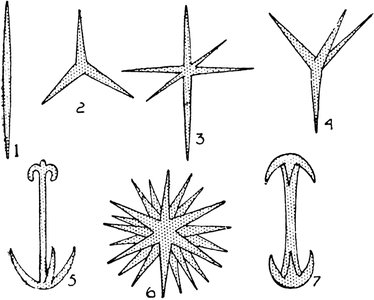
Spicules are structural elements that provide support and deter predators.
They can be composed of silica, calcium carbonate, or spongin (a protein).
Spicules vary in shape and size, aiding in sponge classification.
Phylum Cnidaria
General Characteristics of Cnidarians
Cnidarians include jellyfish, corals, and sea anemones. They are among the earliest animals with true tissues and exhibit greater complexity than sponges.
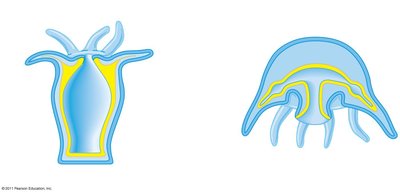
Diploblastic: Composed of two cell layers (epidermis and gastrodermis) separated by a gelatinous mesoglea.
Radial symmetry: Body parts arranged around a central axis.
Possess specialized stinging cells called cnidocytes containing nematocysts for prey capture and defense.
Two main body forms:
Polyp: Sessile, asexual stage (e.g., sea anemones).
Medusa: Free-swimming, sexual stage (e.g., jellyfish).
Major Classes of Cnidaria
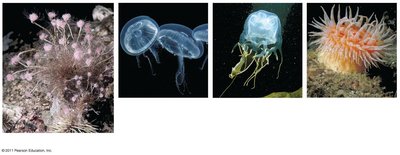
Hydrozoa: Both polyp and medusa stages; often colonial (e.g., Hydra).
Scyphozoa: True jellyfish; medusa stage dominant.
Cubozoa: Box jellies; medusa stage dominant, highly toxic.
Anthozoa: Corals and sea anemones; polyp stage only.
Class | Dominant Form | Examples |
|---|---|---|
Hydrozoa | Polyp & Medusa | Hydra, Obelia |
Scyphozoa | Medusa | Moon jelly |
Cubozoa | Medusa | Box jelly |
Anthozoa | Polyp | Corals, sea anemones |
Life Cycle and Feeding
Cnidarians alternate between polyp and medusa forms (except Anthozoa).
They use tentacles with nematocysts to capture and immobilize prey.
Digestion occurs in the gastrovascular cavity, a central compartment with a single opening serving as both mouth and anus.
Invertebrate Phylogeny and Evolution
Evolutionary Relationships
Sponges (Porifera) are the sister group to all other animals, diverging early from the common ancestor.
Cnidarians are part of the clade Eumetazoa, which includes all animals with true tissues.
Both groups provide insight into the transition from unicellular to multicellular life and the evolution of tissues and body symmetry.
Colonization of Land by Invertebrates
While Porifera and Cnidaria are exclusively aquatic, later invertebrate groups evolved adaptations for terrestrial life.
Key adaptations for land colonization include the development of protective coverings, specialized respiratory structures, and reproductive strategies independent of water.
References: Reece, J.B., Urry, L.A., Cain, M.L., Wasserman, S.A., Minorsky, P.V., and R.B. Jackson. 2014. Campbell Biology, 10th edition. Pearson, New York.
