 Back
BackAnimal Diversity, Physiology, and Circulation: Study Guide for BIOL 191A (Ch. 27, 32, 33, 34)
Study Guide - Smart Notes
 Tailored notes based on your materials, expanded with key definitions, examples, and context.
Animal Evolution and Diversity
Origin of Animals and Early-Diverging Lineages (Ch. 27.1)
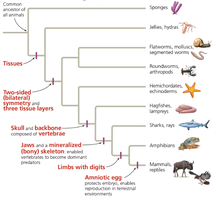
The animal kingdom is believed to have originated from a common ancestor, with early-diverging lineages displaying key evolutionary innovations. The earliest animals, such as sponges, lack true tissues, while more derived groups possess specialized tissues and complex body plans.
Tissues: Groups of cells with a common structure and function, first appearing after sponges.
Bilateral symmetry and three tissue layers: Bilaterians exhibit symmetry and three germ layers (ectoderm, mesoderm, endoderm), allowing for more complex structures.
Invertebrates: Animals without a backbone, making up the majority of animal diversity.
Chordates: Animals with a notochord, dorsal hollow nerve cord, pharyngeal slits, and a post-anal tail at some stage.
The Cambrian Explosion and Animal Body Plans (Ch. 27.2-27.3)
The Cambrian explosion (about 535–525 million years ago) marks a period of rapid diversification, with the emergence of most major animal phyla and the development of complex body plans.
Body plan: The integrated set of morphological and developmental traits of an organism.
Milestones: Evolution of hard body parts, bilateral symmetry, and segmentation.
Major groups: Arthropods (segmented, jointed appendages, exoskeleton), chordates (notochord, dorsal nerve cord), and others.
Colonization of Land and Amniote Adaptations (Ch. 27.5-27.6)
Arthropods and tetrapods were among the first animals to colonize land. Amniotes, including reptiles, birds, and mammals, evolved adaptations for terrestrial life, such as the amniotic egg.
Amniotic egg: Contains membranes that protect the embryo, allowing reproduction away from water.
Amniotes: Mammals, birds, and reptiles; characterized by adaptations like waterproof skin and efficient lungs.
Animal Structure and Function
Levels of Organization and Animal Tissues (Ch. 32.1)
Animals exhibit hierarchical organization, from cells to organ systems. There are four major tissue types, each with specialized functions.
Levels of organization: Cell → Tissue → Organ → Organ system → Organism
Epithelial tissue: Covers body surfaces and lines cavities (e.g., skin, lining of gut).
Connective tissue: Supports and binds other tissues (e.g., bone, blood, cartilage).
Muscle tissue: Enables movement (e.g., skeletal, cardiac, smooth muscle).
Nervous tissue: Conducts electrical impulses (e.g., brain, nerves).
Coordination and Control: Endocrine vs. Nervous System (Ch. 32.2)
Animals coordinate and control body functions using the endocrine and nervous systems. These systems differ in speed, duration, and mechanism of action.
Endocrine system: Uses hormones for long-distance, slower, but longer-lasting signaling.
Nervous system: Uses electrical impulses for rapid, short-term responses.
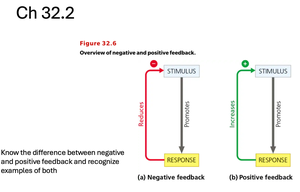
Negative feedback: A process that reduces the stimulus (e.g., body temperature regulation).
Positive feedback: A process that amplifies the stimulus (e.g., childbirth contractions).
Regulation and Homeostasis (Ch. 32.3-32.4)
Homeostasis is the maintenance of a stable internal environment. Animals may be regulators (maintain constant internal conditions) or conformers (internal conditions change with the environment).
Thermoregulation: Maintaining body temperature within a tolerable range.
Endothermic: Generate heat metabolically (e.g., mammals, birds).
Ectothermic: Rely on external heat sources (e.g., reptiles, amphibians).
Osmoregulation: Control of water and solute balance.
Excretion: Removal of metabolic wastes (e.g., ammonia, urea, uric acid).
Excretory process: Filtration → Reabsorption → Secretion → Excretion
Kidney: Main organ for osmoregulation and excretion in vertebrates.
Animal Nutrition
Nutritional Needs and Essential Nutrients (Ch. 33.1)
Animals require food for energy, organic molecules, and essential nutrients. Essential nutrients cannot be synthesized and must be obtained from the diet.
Major nutritional needs: Chemical energy, organic building blocks, essential nutrients.
Essential nutrients: Amino acids, fatty acids, vitamins, minerals.
Malnutrition: Deficiency or excess of essential nutrients.
Food Processing and Digestive Adaptations (Ch. 33.2, 33.4)
Food processing occurs in four stages: ingestion, digestion, absorption, and elimination. Animals have diverse digestive systems adapted to their diets.
Mechanical digestion: Physical breakdown of food (e.g., chewing).
Chemical digestion: Enzymatic breakdown of macromolecules.
Digestive systems: Gastrovascular cavity (single opening) vs. alimentary canal (complete tract).
Adaptations: Ruminants have specialized stomachs for herbivory; carnivores have shorter guts.
Glucose Homeostasis (Ch. 33.5)
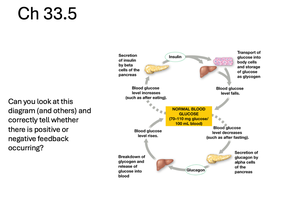
Blood glucose levels are regulated by the hormones insulin and glucagon, maintaining homeostasis through negative feedback mechanisms.
Insulin: Lowers blood glucose by promoting uptake and storage.
Glucagon: Raises blood glucose by stimulating release from stores.
Negative feedback: Maintains glucose within a narrow range.
Circulation and Gas Exchange
Circulatory System Structure and Function (Ch. 34.1)
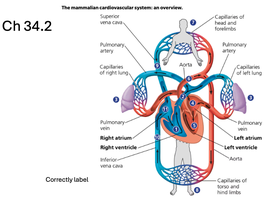
The circulatory system transports nutrients, gases, and wastes. It consists of the heart, blood vessels, and blood. There are two main types: open and closed systems.
Open system: Hemolymph bathes organs directly (e.g., arthropods).
Closed system: Blood confined to vessels (e.g., vertebrates).
Blood vessels: Arteries (away from heart), veins (toward heart), capillaries (exchange).
Single vs. double circulation: Single (fish), double (amphibians, mammals).
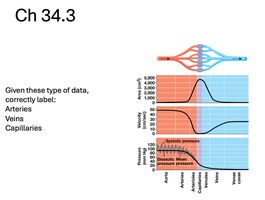
Blood Vessel Properties (Ch. 34.3)
Blood vessels differ in diameter, velocity, and pressure. Arteries have thick walls and high pressure, capillaries are thin for exchange, and veins have valves and lower pressure.
Arteries: High pressure, fast velocity, thick walls.
Capillaries: Smallest diameter, slowest velocity, site of exchange.
Veins: Lower pressure, larger diameter, return blood to heart.
Gas Exchange and Respiratory Adaptations (Ch. 34.5-34.6)
Gas exchange involves the uptake of oxygen and release of carbon dioxide. Adaptations include gills (countercurrent exchange), tracheal systems (insects), and lungs (terrestrial vertebrates).
Countercurrent exchange: Maximizes oxygen uptake in gills.
Tracheal system: Delivers air directly to tissues in insects.
Lungs: Infolded respiratory surfaces in vertebrates.
