 Back
BackAnimal Evolution, Physiology, and Homeostasis: Study Guide for BIOL 191A (Units 3, Ch. 27, 32, 33, 34)
Study Guide - Smart Notes
 Tailored notes based on your materials, expanded with key definitions, examples, and context.
Animal Evolution and Body Plans
Origin and Early Evolution of Animals
The animal kingdom is characterized by a remarkable diversity of forms and functions, all tracing back to a common ancestor. The earliest animals were simple, but over time, evolutionary innovations led to the complex body plans seen today.
Evidence for Animal Origins: Fossil records and molecular data suggest animals evolved from a group of protists about 700 million years ago.
Early-Diverging Lineages: Sponges (Porifera) are among the earliest animals, lacking true tissues. Cnidarians (jellies, hydras) were among the first to develop tissues.
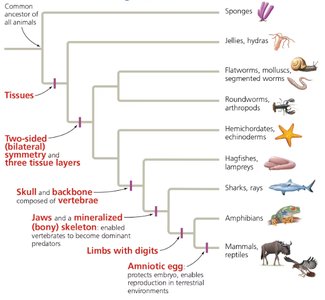
Key Innovations: The development of tissues, bilateral symmetry, and three germ layers (triploblasty) were major milestones.
The Cambrian Explosion and Animal Body Plans
The Cambrian explosion (about 535–525 million years ago) was a period of rapid evolutionary diversification, resulting in the appearance of most major animal phyla.
Body Plan: A set of morphological and developmental traits integrated into a functional whole.
Bilateral Symmetry: Animals with a left and right side, associated with the development of a head (cephalization).
Invertebrates vs. Chordates: Invertebrates lack a backbone and make up 95% of animal species. Chordates possess a notochord, dorsal nerve cord, pharyngeal slits, and a post-anal tail at some stage.
Major Milestones in Vertebrate Evolution
Vertebrae: The evolution of a backbone provided structural support and protection for the nerve cord.
Jaws and Mineralized Skeleton: Enabled vertebrates to become dominant predators.
Limbs with Digits: Allowed vertebrates to move onto land.
Amniotic Egg: A key adaptation for terrestrial life, protecting the embryo and enabling reproduction away from water.
Colonization of Land
Arthropods: First animals to colonize land, with adaptations such as exoskeletons and jointed appendages.
Tetrapods: Vertebrates with limbs and digits, including amphibians, reptiles, birds, and mammals.
Amniotes: Tetrapods with an amniotic egg, including reptiles (birds are reptiles) and mammals.
Animal Structure and Function
Levels of Organization in Animals
Animals exhibit hierarchical organization, from cells to the whole organism.
Cell → Tissue → Organ → Organ System → Organism
Tissue: An integrated group of cells with a common structure and function.
Major Categories of Animal Tissue
Epithelial Tissue: Sheets of tightly packed cells covering body surfaces and lining organs (e.g., skin, lining of the gut).
Connective Tissue: Binds and supports other tissues (e.g., bone, blood, cartilage).
Muscle Tissue: Responsible for movement (e.g., skeletal, cardiac, smooth muscle).
Nervous Tissue: Senses stimuli and transmits signals (e.g., brain, nerves).
Coordination and Control: Endocrine and Nervous Systems
Overview of Coordination and Control
Animals use two major systems to coordinate and control bodily functions: the endocrine system and the nervous system.
Endocrine System: Uses hormones for long-distance signaling; effects are generally slower but longer-lasting.
Nervous System: Uses electrical signals for rapid, short-term responses.
Feedback Regulation
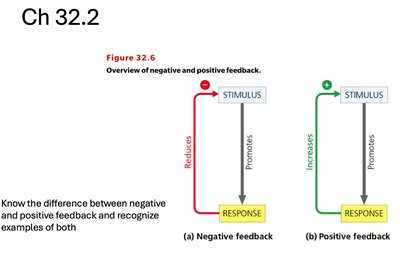
Feedback mechanisms maintain homeostasis by regulating physiological processes.
Negative Feedback: Reduces the stimulus, maintaining stability (e.g., body temperature regulation).
Positive Feedback: Amplifies the stimulus, driving processes to completion (e.g., childbirth contractions).
Simple vs. Neuroendocrine Signaling
Simple Endocrine Signaling: Endocrine cells release hormones directly into the bloodstream.
Neuroendocrine Signaling: Neurons release neurohormones into the blood, affecting distant targets.
Hormone Solubility
Water-Soluble Hormones: Bind to cell surface receptors (e.g., insulin).
Lipid-Soluble Hormones: Pass through cell membranes and bind to intracellular receptors (e.g., steroid hormones).
Homeostasis and Regulation
Regulators vs. Conformers
Regulators: Maintain internal conditions despite external changes (e.g., mammals regulate body temperature).
Conformers: Allow internal conditions to change with the environment (e.g., many fish conform to water temperature).
Thermoregulation
Endothermic: Generate heat by metabolism (e.g., birds, mammals).
Ectothermic: Gain heat from external sources (e.g., reptiles, amphibians, fish).
Circulatory Adaptations: Include vasodilation/vasoconstriction, countercurrent exchange, and insulation.
Osmoregulation and Excretion
Osmoregulation: Regulation of solute concentrations and water balance.
Osmoconformers: Match their internal osmolarity to the environment (e.g., marine invertebrates).
Osmoregulators: Control internal osmolarity (e.g., freshwater fish, mammals).
Excretion: Removal of metabolic wastes, especially nitrogenous wastes (ammonia, urea, uric acid).
Excretory Process Steps: Filtration, reabsorption, secretion, elimination.
Kidney: Main organ for excretion and osmoregulation in vertebrates.
Animal Nutrition
Nutritional Needs and Essential Nutrients
Major Nutritional Needs: Chemical energy, organic building blocks, essential nutrients.
Essential Nutrients: Amino acids, fatty acids, vitamins, minerals.
Malnutrition: Deficiency or excess of essential nutrients.
Food Processing Stages
Ingestion: Eating or feeding.
Digestion: Mechanical and chemical breakdown of food.
Absorption: Uptake of nutrients by body cells.
Elimination: Removal of undigested material.
Glucose Homeostasis
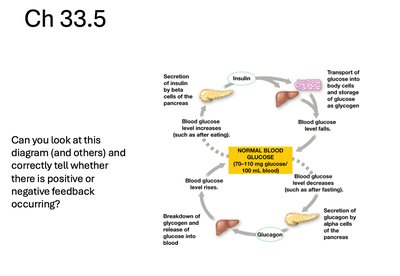
Blood glucose levels are tightly regulated by the hormones insulin and glucagon, maintaining homeostasis through negative feedback.
Insulin: Lowers blood glucose by promoting uptake and storage.
Glucagon: Raises blood glucose by promoting breakdown of glycogen.
Circulation and Gas Exchange
Structure and Function of Circulatory Systems
Circulatory systems transport nutrients, gases, and wastes throughout the body. They can be open or closed, with different animal groups exhibiting each type.
Open Circulatory System: Hemolymph bathes organs directly (e.g., arthropods, most mollusks).
Closed Circulatory System: Blood is confined to vessels (e.g., annelids, vertebrates).
Blood Vessels and Circulation Types
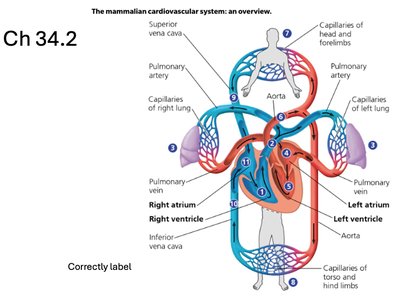
Arteries: Carry blood away from the heart.
Capillaries: Sites of exchange with tissues.
Veins: Carry blood toward the heart.
Single Circulation: Blood passes through the heart once per circuit (e.g., fish).
Double Circulation: Blood passes through the heart twice per circuit (e.g., mammals, birds).
Structure of the Mammalian Heart and Cardiac Cycle
Four Chambers: Right atrium, right ventricle, left atrium, left ventricle.
Cardiac Cycle: Alternating contraction (systole) and relaxation (diastole) of the heart.
Gas Exchange and Respiratory Adaptations
Gas Exchange: Uptake of O2 and release of CO2.
Gills: Use countercurrent exchange to maximize O2 uptake.
Tracheal System: In insects, delivers air directly to tissues.
Lungs: Internal respiratory surfaces in terrestrial vertebrates.
Additional info: Some explanations and examples have been expanded for clarity and completeness based on standard biology curriculum.
