 Back
BackAnimal Evolution, Physiology, Nutrition, and Circulation: BIOL 191A Unit 3 Study Guide
Study Guide - Smart Notes
 Tailored notes based on your materials, expanded with key definitions, examples, and context.
Animal Evolution and Body Plans
Origin and Early-Diverging Animal Lineages (Ch 27.1)
The origin of animals is traced to a common ancestor, with evidence from molecular and fossil records. Early-diverging lineages include sponges, cnidarians, and ctenophores, which exhibit simple body plans and lack complex tissues.
Sponges: Lack true tissues; simple multicellular structure.
Cnidarians and Ctenophores: Possess tissues and radial symmetry.
Bilaterians: Exhibit bilateral symmetry and three germ layers (ectoderm, mesoderm, endoderm).
Major Milestones in Animal Evolution: Cambrian Explosion (Ch 27.2)
The Cambrian explosion (535–525 million years ago) marked a rapid diversification of animal body plans, including the emergence of hard-bodied forms and most present-day phyla.
Key traits: Development of tissues, bilateral symmetry, and complex organs.
Evolutionary innovations: Skeletons, segmentation, and specialized appendages.
Animal Body Plans and Major Traits (Ch 27.3)
Animal body plans are defined by symmetry, tissue organization, and developmental patterns. Invertebrates and chordates are distinguished by the presence or absence of a backbone.
Invertebrates: Lack a backbone; include arthropods, mollusks, annelids, etc.
Chordates: Possess a notochord, dorsal nerve cord, pharyngeal slits, and post-anal tail at some stage.
Tetrapods: Vertebrates with limbs and digits.
Animal Phylogeny and Evolutionary Traits
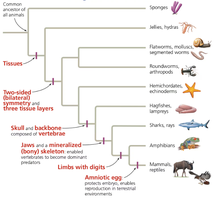
The animal phylogeny illustrates the evolutionary relationships and key innovations among major animal groups.
Tissues: First major innovation after sponges.
Bilateral symmetry and three tissue layers: Emerged in bilaterians.
Skull and backbone: Characteristic of vertebrates.
Jaws and mineralized skeleton: Seen in sharks and ray-finned fishes.
Limbs with digits: Tetrapod adaptation.
Amniotic egg: Key trait of amniotes (mammals, birds, reptiles).
Colonization of Land by Arthropods and Tetrapods (Ch 27.5)
Arthropods (insects, spiders) and tetrapods (amphibians, reptiles, mammals) were among the first animals to colonize land, developing adaptations for terrestrial life.
Arthropods: Exoskeleton, jointed appendages, respiratory adaptations.
Tetrapods: Limbs with digits, lungs, and skin adaptations.
Adaptations in Amniotes (Ch 27.6)
Amniotes evolved the amniotic egg, enabling reproduction away from water and further adaptation to terrestrial environments.
Amniotic egg: Specialized membranes protect the embryo.
Present-day amniotes: Mammals (hair, mammary glands), birds and reptiles (scales, feathers).
Animal Physiology and Homeostasis
Levels of Organization and Tissue Types (Ch 32.1)
Animals exhibit five levels of organization: cells, tissues, organs, organ systems, and the organism. Four major tissue types are:
Epithelial tissue: Covers surfaces; e.g., skin, lining of gut.
Connective tissue: Supports and binds; e.g., bone, blood.
Muscle tissue: Contracts for movement; e.g., skeletal, cardiac, smooth muscle.
Nervous tissue: Conducts electrical signals; e.g., brain, nerves.
Coordination and Control: Endocrine vs Nervous System (Ch 32.2)
Animals coordinate responses via the endocrine and nervous systems. The endocrine system uses hormones for slower, long-lasting regulation, while the nervous system uses rapid electrical signals.
Endocrine system: Hormones secreted by glands, affecting distant targets.
Nervous system: Neurons transmit signals quickly to specific targets.
Negative and Positive Feedback Regulation
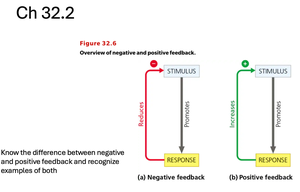
Feedback mechanisms maintain homeostasis. Negative feedback counteracts changes, while positive feedback amplifies them.
Negative feedback: Response reduces the stimulus (e.g., temperature regulation).
Positive feedback: Response increases the stimulus (e.g., blood clotting).
Simple vs Neuroendocrine Signaling
Simple signaling: Direct hormone action on target cells.
Neuroendocrine signaling: Nervous system triggers hormone release.
Water-Soluble vs Lipid-Soluble Hormones
Water-soluble: Act on cell surface receptors (e.g., insulin).
Lipid-soluble: Act on intracellular receptors (e.g., steroid hormones).
Regulators vs Conformers; Thermoregulation (Ch 32.3)
Regulators: Maintain internal conditions despite external changes.
Conformers: Internal conditions change with the environment.
Thermoregulation: Maintenance of body temperature.
Endothermic: Generate heat metabolically (e.g., mammals).
Ectothermic: Rely on external heat sources (e.g., reptiles).
Circulatory Adaptations for Thermoregulation
Vasodilation and vasoconstriction
Countercurrent heat exchange
Insulation (fur, fat)
Osmoregulation and Excretion (Ch 32.4)
Osmoregulation: Regulation of solute and water balance.
Excretion: Removal of metabolic wastes.
Osmoconformers: Match internal osmolarity to environment.
Osmoregulators: Maintain constant internal osmolarity.
Excretory Process Steps
Filtration
Reabsorption
Secretion
Elimination
Kidney: Central organ for excretion and homeostasis.
Animal Nutrition and Digestion
Major Nutritional Needs and Essential Nutrients (Ch 33.1)
Animals require energy, organic molecules, and essential nutrients from their diet. Essential nutrients include amino acids, fatty acids, vitamins, and minerals.
Essential amino acids: Must be obtained from food.
Essential fatty acids: Required for cell membranes.
Vitamins: Organic cofactors.
Minerals: Inorganic nutrients.
Food Processing Stages (Ch 33.2)
Ingestion: Eating food.
Digestion: Mechanical and chemical breakdown.
Absorption: Uptake of nutrients.
Elimination: Removal of undigested material.
Mechanical vs Chemical Digestion
Mechanical: Physical breakdown (e.g., chewing).
Chemical: Enzymatic breakdown (e.g., stomach acid).
Glucose Homeostasis (Ch 33.5)
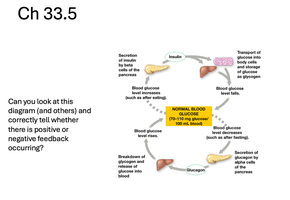
Blood glucose levels are regulated by insulin and glucagon through negative feedback mechanisms.
Insulin: Lowers blood glucose by promoting uptake and storage.
Glucagon: Raises blood glucose by promoting breakdown and release.
Circulation and Gas Exchange
Structure and Function of Circulatory Systems (Ch 34.1)
Circulatory systems transport nutrients, gases, and wastes. They can be open (hemolymph bathes tissues) or closed (blood confined to vessels).
Open system: In arthropods, mollusks.
Closed system: In vertebrates, annelids.
Blood Vessels
Arteries: Carry blood away from heart.
Capillaries: Exchange with tissues.
Veins: Carry blood toward heart.
Single vs Double Circulation
Single: Fish; one circuit.
Double: Mammals, birds; pulmonary and systemic circuits.
Structure of the Heart and Cardiac Cycle (Ch 34.2)
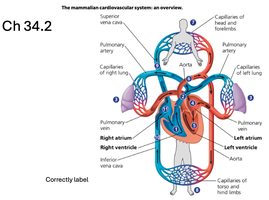
The heart is a muscular organ with chambers (atria, ventricles) that pump blood through the circulatory system. The cardiac cycle alternates contraction (systole) and relaxation (diastole).
Functions of Blood Vessels (Ch 34.3)
Arteries: High pressure, fast blood flow.
Capillaries: Small diameter, slow flow, exchange.
Veins: Low pressure, return blood to heart.
Gas Exchange and Respiratory Adaptations (Ch 34.5-34.6)
Gas exchange: Oxygen uptake, CO2 removal.
Gills: Countercurrent exchange maximizes oxygen uptake.
Tracheal system: In insects, direct air delivery.
Lungs: In vertebrates, air sacs for gas exchange.
Breathing: Varies among animal groups; mammals use diaphragm.
Key Terms Table
Term | Definition |
|---|---|
Amniote | Tetrapod with amniotic egg; includes mammals, birds, reptiles |
Arthropod | Segmented animal with exoskeleton and jointed appendages |
Bilaterian | Animal with bilateral symmetry and three germ layers |
Chordate | Animal with notochord, dorsal nerve cord, pharyngeal slits, post-anal tail |
Invertebrate | Animal without a backbone |
Mammal | Amniote with hair and mammary glands |
Reptile | Amniote including lizards, snakes, turtles, crocodilians, birds |
Tetrapod | Vertebrate with limbs and digits |
Vertebrate | Chordate with a backbone |
Homeostasis | Steady-state physiological condition |
Negative feedback | Regulation that counteracts change |
Positive feedback | Regulation that amplifies change |
Osmoregulation | Regulation of solute and water balance |
Excretion | Removal of metabolic wastes |
Essential nutrient | Required nutrient not synthesized by organism |
Insulin | Hormone lowering blood glucose |
Glucagon | Hormone raising blood glucose |
Artery | Vessel carrying blood away from heart |
Vein | Vessel carrying blood toward heart |
Capillary | Microscopic vessel for exchange |
Countercurrent exchange | Exchange between fluids flowing in opposite directions |
