 Back
BackAnimal Evolution, Physiology, Nutrition, and Circulation: Study Guide for BIOL 191A
Study Guide - Smart Notes
 Tailored notes based on your materials, expanded with key definitions, examples, and context.
Animal Evolution and Body Plans
Origin and Early-Diverging Animal Lineages (Ch 27.1)
The origin of animals is traced to a common ancestor, with evidence from fossil records and molecular data. Early-diverging lineages include sponges, cnidarians, and bilaterians, each characterized by distinct traits.
Sponges: Lack true tissues; simple body structure.
Cnidarians (e.g., jellyfish, hydras): Possess tissues and radial symmetry.
Bilaterians: Exhibit bilateral symmetry and three germ layers (ectoderm, mesoderm, endoderm).
Example: Sponges are considered basal animals due to their lack of tissues, while cnidarians represent an early branch with simple tissue organization. 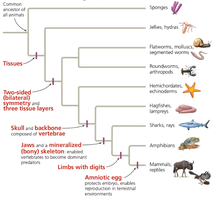
Cambrian Explosion and Animal Evolution (Ch 27.2)
The Cambrian explosion (535–525 million years ago) marks a period of rapid diversification, with the emergence of most major animal phyla.
Milestones: Appearance of hard-bodied animals, development of complex body plans, and increased predation.
Traits: Bilateral symmetry, segmentation, and specialized tissues.
Example: Fossils from the Cambrian period show the first evidence of arthropods and chordates.
Animal Body Plans and Major Traits (Ch 27.3)
Animal body plans are defined by symmetry, tissue layers, and developmental patterns.
Bilateral symmetry: Allows for directional movement and cephalization.
Invertebrates: Animals without a backbone; include arthropods, mollusks, and worms.
Chordates: Defined by notochord, dorsal nerve cord, pharyngeal slits, and post-anal tail.
Example: Arthropods have segmented bodies and jointed appendages, while chordates possess a notochord during development.
Colonization of Land by Arthropods and Tetrapods (Ch 27.5)
Arthropods (e.g., insects, spiders) and tetrapods (e.g., amphibians, reptiles, mammals) were among the first animals to colonize land.
Arthropods: Adaptations include exoskeletons and jointed limbs.
Tetrapods: Development of limbs with digits enabled movement on land.
Example: Amphibians represent early tetrapods, transitioning from aquatic to terrestrial environments.
Adaptations in Amniotes (Ch 27.6)
Amniotes (mammals, birds, reptiles) evolved adaptations for terrestrial life, notably the amniotic egg.
Amniotic egg: Protects embryo, enables reproduction away from water.
Present-day traits: Mammals have hair and mammary glands; reptiles have scales and lay amniotic eggs.
Example: Birds and mammals are amniotes with specialized adaptations for land.
Animal Physiology and Homeostasis
Levels of Organization and Tissue Types (Ch 32.1)
Animals exhibit five levels of organization: cells, tissues, organs, organ systems, and organisms. Four major tissue types are:
Epithelial tissue: Covers surfaces; e.g., skin, lining of gut.
Connective tissue: Supports and binds; e.g., bone, blood.
Muscle tissue: Contracts for movement; e.g., skeletal, cardiac muscle.
Nervous tissue: Conducts signals; e.g., brain, nerves.
Example: The heart contains muscle, connective, and nervous tissues.
Coordination and Control: Endocrine vs Nervous System (Ch 32.2)
Animals coordinate responses via the endocrine and nervous systems.
Endocrine system: Uses hormones for slow, long-lasting regulation.
Nervous system: Uses electrical signals for rapid, short-term responses.
Example: Hormones regulate growth, while nerves control reflexes.
Feedback Regulation (Ch 32.2)
Feedback mechanisms maintain homeostasis.
Negative feedback: Reduces stimulus; e.g., temperature regulation.
Positive feedback: Amplifies stimulus; e.g., blood clotting.
Example: Sweating cools the body via negative feedback. 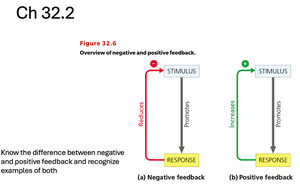
Regulators vs Conformers and Thermoregulation (Ch 32.3)
Regulators: Maintain internal conditions despite external changes.
Conformers: Internal conditions change with the environment.
Thermoregulation: Endotherms generate heat metabolically; ectotherms rely on external sources.
Example: Mammals are endothermic regulators; fish are often ectothermic conformers.
Osmoregulation and Excretion (Ch 32.4)
Osmoregulation controls solute and water balance; excretion removes waste.
Osmoregulators: Maintain constant osmolarity; e.g., freshwater fish.
Osmoconformers: Match environmental osmolarity; e.g., marine invertebrates.
Excretory process: Filtration, reabsorption, secretion, elimination.
Kidney: Key organ for homeostasis and excretion.
Example: The kidney filters blood, reabsorbs water, and excretes urea.
Animal Nutrition and Digestion
Nutritional Needs and Essential Nutrients (Ch 33.1)
Animals require energy, organic molecules, and essential nutrients. Four classes of essential nutrients:
Essential amino acids
Essential fatty acids
Vitamins
Minerals
Example: Humans must obtain vitamin C from their diet.
Food Processing Stages (Ch 33.2)
Four stages: ingestion, digestion, absorption, elimination.
Mechanical digestion: Physical breakdown (e.g., chewing).
Chemical digestion: Enzymatic breakdown (e.g., stomach acids).
Example: The alimentary canal is a complete digestive tract from mouth to anus.
Glucose Homeostasis (Ch 33.5)
Blood glucose is regulated by insulin and glucagon via negative feedback.
Insulin: Lowers blood glucose by promoting uptake and storage.
Glucagon: Raises blood glucose by promoting breakdown and release.
Example: After eating, insulin is secreted; during fasting, glucagon is secreted. 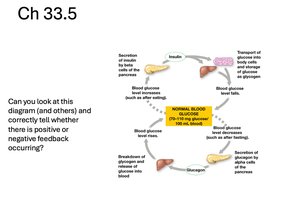
Circulation and Gas Exchange
Structure and Function of Circulatory Systems (Ch 34.1)
Circulatory systems transport nutrients, gases, and wastes.
Open system: Hemolymph bathes tissues directly; found in arthropods.
Closed system: Blood confined to vessels; found in vertebrates.
Example: Mammals have a closed cardiovascular system.
Blood Vessels and Circulation Types (Ch 34.1, 34.3)
Three main blood vessels:
Arteries: Carry blood away from heart; high pressure.
Veins: Carry blood toward heart; lower pressure.
Capillaries: Exchange sites; thin walls.
Single circulation: Blood passes through heart once per cycle (e.g., fish). Double circulation: Blood passes through heart twice (e.g., mammals). 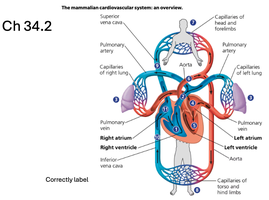
Cardiac Cycle and Blood Vessel Properties (Ch 34.2, 34.3)
The cardiac cycle alternates between contraction (systole) and relaxation (diastole).
Arteries: Largest diameter, highest pressure.
Capillaries: Smallest diameter, slowest velocity, largest area.
Veins: Lower pressure, return blood to heart.
Example: Blood pressure is highest in arteries, lowest in veins. 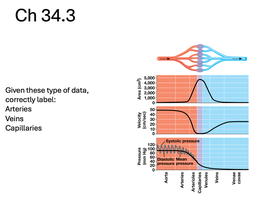
Gas Exchange and Respiratory Adaptations (Ch 34.5, 34.6)
Gas exchange involves uptake of O2 and release of CO2.
Gills: Use countercurrent exchange for efficient O2 uptake.
Tracheal system: In insects, delivers O2 directly to cells.
Lungs: In vertebrates, site of gas exchange via alveoli.
Example: Fish gills maximize O2 absorption using countercurrent flow.
Tables
Comparison of Blood Vessel Properties
Vessel Type | Diameter | Area | Velocity | Pressure |
|---|---|---|---|---|
Arteries | Large | Low | High | High |
Capillaries | Small | High | Low | Low |
Veins | Medium | Low | Medium | Lowest |
Additional info: Table inferred from blood vessel data and textbook context.
Summary of Feedback Regulation
Type | Mechanism | Example |
|---|---|---|
Negative Feedback | Reduces stimulus | Temperature regulation, blood glucose |
Positive Feedback | Amplifies stimulus | Blood clotting, childbirth |
Additional info: Table inferred from feedback diagrams and textbook context. ----------------------------------------
