 Back
BackAnimal Form, Function, and Bioenergetics: Principles of Physiology and Thermoregulation
Study Guide - Smart Notes
 Tailored notes based on your materials, expanded with key definitions, examples, and context.
Animal Form and Function
Correlation of Form and Function at All Levels of Organization
Animal form and function are closely linked, with anatomical structures often providing clues to physiological roles. This relationship is evident from the cellular to the organismal level.
- Key Point 1: All animals must obtain nutrients and oxygen, fight infection, and reproduce.
- Key Point 2: Structure and function are correlated; anatomy often predicts physiology (biological function)
Evolution of Animal Size and Shape
Physical laws, such as those governing strength, diffusion, and heat exchange, constrain animal body plans. Convergent evolution leads to similar adaptations in unrelated species facing similar environmental challenges.
- Key Point 1: Properties of water limit shapes for fast-swimming animals.
- Key Point 2: Larger animals require thicker skeletons and more muscle mass for support and movement. - Example: Seal, penguin, and tuna have streamlined bodies for efficient swimming. 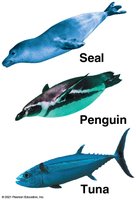
Exchange with the Environment
Efficient exchange of materials (nutrients, gases, wastes) is essential for animal survival. The rate of exchange depends on surface area, while the amount exchanged depends on volume.
- Key Point 1: Single-celled organisms have high surface-to-volume ratios, facilitating exchange.
- Key Point 2: Multicellular organisms require specialized structures for exchange. 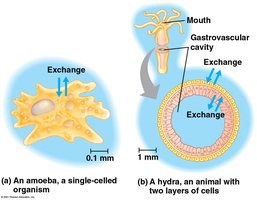
Multicellular Organization and Body Shape
Multicellular animals must ensure all cells have access to an aqueous environment. Body shape and internal organization evolve to maximize exchange.
- Key Point 1: Flat animals have most cells in direct contact with the environment.
- Key Point 2: Complex animals develop branched or folded structures to increase surface area. 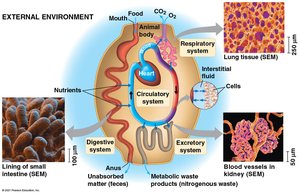
Hierarchical Organization of Body Plans
Animal bodies are organized hierarchically: cells form tissues, tissues form organs, and organs form organ systems. Some organs, like the pancreas, serve multiple systems. (CTOOS)
Animal Tissues
Types of Animal Tissues
There are four main types of animal tissues, each with distinct functions:
Type | Function |
|---|---|
Epithelial | Covers the outside of the body and lines the organs and cavities |
Connective | holds many tissues and organs together in place |
Muscle | Enables movement |
Nervous | Receives, processes, and transmits information |
Epithelial Tissue
Epithelial tissue forms protective layers and lines organs and cavities. Cell shapes include cuboidal, columnar, and squamous.
- Key Point: Cells are tightly packed, forming barriers. - Example: Stratified squamous epithelium protects surfaces; simple columnar epithelium lines intestines. 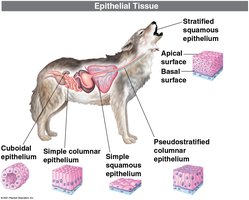
Connective Tissue
Connective tissue supports and binds other tissues. It contains fibroblasts (produce fibers) and macrophages (immune defense).
- Key Point: Matrix may be liquid, jellylike, or solid. - Types: Loose, fibrous, bone (mineralized and forms the skeleton), adipose (stores fat for insulation and fuel), blood (composed of blood cells and cell fragments in blood plasma), cartilage.
Muscle Tissue
Muscle tissue is responsible for movement, composed of actin and myosin filaments. - Types: Skeletal (voluntary), smooth (involuntary), cardiac (heart contraction). 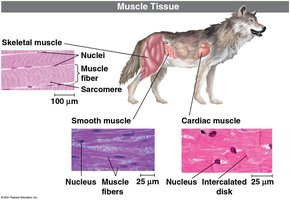
Nervous Tissue
Nervous tissue transmits information via neurons and supports cells (glia).
- Key Point: Neurons transmit impulses; glia support neurons.
Coordination and Control: Endocrine and Nervous Systems
Endocrine System (signaling system)
The endocrine system releases hormones for gradual, sustained changes.
- Key Point: Hormones travel via bloodstream, affecting multiple targets.
Nervous System (transmits information along dedicated routes, connecting specific locations in the body)
The nervous system transmits rapid, targeted signals via nerve impulses.
- Key Point: Information depends on signal pathway; responses are quick and short-lived. 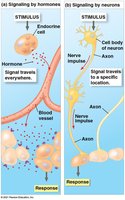
Homeostasis and Feedback Control
Regulating and Conforming
Animals regulate or conform to environmental variables.
- Regulator: Maintains internal stability despite external changes.
- Conformer: Internal state varies with environment. 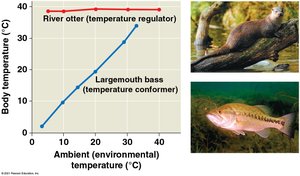
Mechanisms of Homeostasis
Homeostasis maintains variables near a set point (where steady state is maintained)
- Key Steps: Stimulus (signal) → Sensor (the thing that senses the signal) → Control Center → Response.( how the animal reacts to a signal) 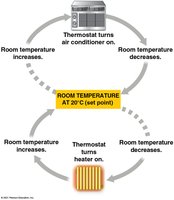
Feedback Control
- Negative Feedback: Reduces stimulus, stabilizing internal environment.
- Positive Feedback: Amplifies stimulus, driving processes to completion (e.g., childbirth).
Alterations in Homeostasis
Set points may change with age or follow circadian rhythms.
- Key Point: Acclimatization( changes in animals physiology in response to its external environment) adjusts physiology to environmental changes. 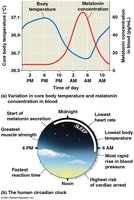
Thermoregulation (how animals maintain an internal temperature)
Endothermy vs. Ectothermy
- Endotherms: Generate heat metabolically (birds, mammals).
- Ectotherms: Gain heat from environment (fishes, amphibians, reptiles, invertebrates). 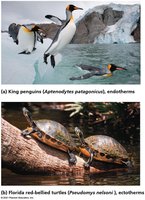
Balancing Heat Loss and Gain
Animals exchange heat via radiation, evaporation, convection, and conduction. 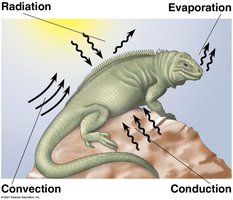
Thermoregulatory Adaptations
Five main adaptations: insulation, circulatory changes, evaporative cooling, behavioral responses, metabolic heat production.
Insulation
Skin, feathers, fur, and blubber reduce heat loss.
Circulatory Adaptations
Vasodilation increases heat loss; vasoconstriction decreases it.
Countercurrent Exchange (transfers heat between fluids flowing in opposite directions which reduces heat loss)
Blood vessels arranged to transfer heat efficiently, reducing loss. 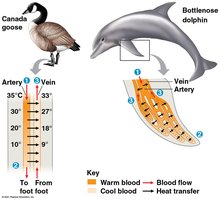
Behavioral Responses
Animals seek or avoid heat sources, change orientation, or huddle for warmth. 
Adjusting Metabolic Heat Production
Thermogenesis increases heat via muscle activity or brown fat.
Acclimatization and Physiological Thermostats
Animals adjust insulation and membrane lipids seasonally; hypothalamus (region of the brain that triggers heat loss or heat generating mechanisms) acts as thermostat. 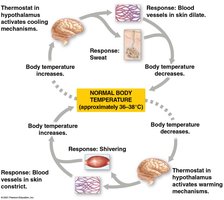
Bioenergetics (the overall flow and transformation of energy in an animal) and Energy Requirements
Energy Allocation and Use
Animals (heterotrophs) obtain energy from food, used for ATP production and biosynthesis. 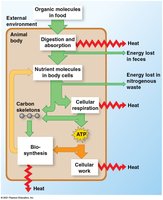
Quantifying Energy Use
Metabolic rate is the total energy used per unit time, measured by heat loss, oxygen consumption, or food/waste analysis.
Minimum Metabolic Rate and Thermoregulation
- BMR: Basal metabolic rate for endotherms at rest.
- SMR: Standard metabolic rate for ectotherms at rest.
Size and Metabolic Rate
Metabolic rate scales with body mass to the 3/4 power. Smaller animals have higher rates per gram. 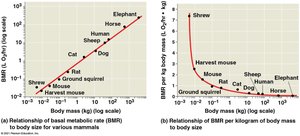
Activity and Metabolic Rate
Maximum metabolic rate is inversely related to activity duration. Daily energy consumption is 2–4 times BMR or SMR.
Torpor (physiologcial state of decreased activity and metabolism) and Energy Conservation
Torpor is a state of reduced activity and metabolism, enabling energy conservation. Hibernation is long-term torpor; estivation is summer torpor. 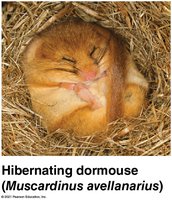 Additional info: These notes cover the main concepts from Chapter 40: Basic Principles of Animal Form and Function, including tissue types, homeostasis, thermoregulation, and bioenergetics, as outlined in the college biology curriculum.
