 Back
BackAtoms, Molecules, and the Chemical Context of Life: Study Notes
Study Guide - Smart Notes
 Tailored notes based on your materials, expanded with key definitions, examples, and context.
Atoms and Molecules
Atomic Structure and Subatomic Particles
Atoms are the fundamental units of matter, composed of subatomic particles: protons, neutrons, and electrons. The structure of the atom determines its chemical properties and behavior.
Proton: Positively charged particle found in the nucleus.
Neutron: Neutral particle found in the nucleus.
Electron: Negatively charged particle found in orbitals around the nucleus.
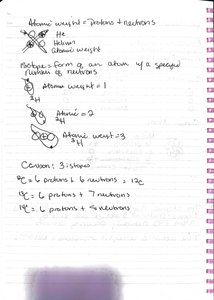
Atomic number is the number of protons in an atom and defines the element. Atomic weight (or mass number) is the sum of protons and neutrons.
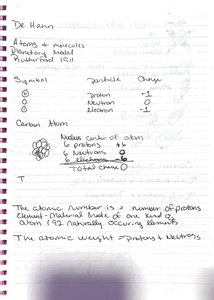
Example: Carbon atom: 6 protons, 6 neutrons, 6 electrons.
Isotopes
Isotopes are forms of an element with the same number of protons but different numbers of neutrons, resulting in different atomic weights.
Example: Carbon-12 (6 protons, 6 neutrons), Carbon-13 (6 protons, 7 neutrons), Carbon-14 (6 protons, 8 neutrons).
Atomic Orbitals and Energy Levels
Potential and Kinetic Energy
Atoms possess potential energy due to the arrangement of electrons in energy levels (shells). Electrons can move between energy levels by absorbing or releasing energy.
Potential energy: Stored energy due to position.
Kinetic energy: Energy of motion.
Electron Orbitals and Quantum Levels
Electrons occupy orbitals, which are regions of space where electrons are likely to be found. Each energy level (shell) contains one or more orbitals.
First shell: 1s orbital (holds 2 electrons)
Second shell: 2s and three 2p orbitals (holds 8 electrons)
Third shell: 3s, three 3p orbitals, etc.
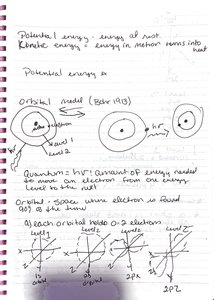
Quantum: The amount of energy required to move an electron from one energy level to another.
Chemical Bonds and Molecules
Covalent and Ionic Bonds
Chemical bonds form when atoms share or transfer electrons to achieve stable electron configurations.
Covalent bond: Atoms share pairs of electrons.
Ionic bond: Atoms transfer electrons, resulting in oppositely charged ions that attract each other.
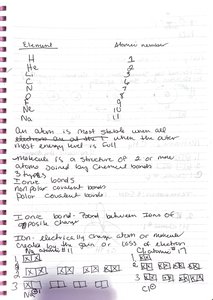
Example: NaCl forms from the transfer of an electron from Na to Cl, creating Na+ and Cl-.
Polar and Nonpolar Covalent Bonds
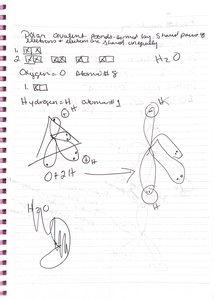
In covalent bonds, electrons may be shared equally (nonpolar) or unequally (polar), depending on the electronegativity of the atoms involved.
Nonpolar covalent bond: Electrons are shared equally (e.g., H2, O2).
Polar covalent bond: Electrons are shared unequally, creating partial charges (e.g., H2O).
Electronegativity and Hydrogen Bonds
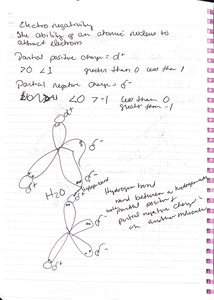
Electronegativity is the ability of an atom to attract electrons in a covalent bond. When atoms with different electronegativities bond, partial charges result, leading to hydrogen bonding between molecules.
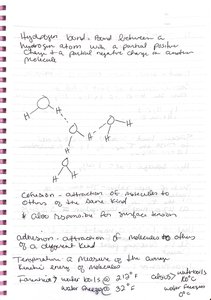
Hydrogen bond: Attraction between a hydrogen atom with a partial positive charge and another atom with a partial negative charge (often oxygen or nitrogen).
Properties of Water
Cohesion, Adhesion, and Temperature Moderation
Water molecules exhibit cohesion (attraction to each other) and adhesion (attraction to other substances), both due to hydrogen bonding. Water also moderates temperature due to its high specific heat and heat of vaporization.
Cohesion: Responsible for surface tension.
Adhesion: Helps water climb up plant vessels.
Specific heat: Amount of heat needed to raise 1g of water by 1°C ().
Heat of vaporization: Amount of heat needed to convert 1g of water to vapor ().
Temperature and Heat Calculations
Temperature is a measure of the average kinetic energy of molecules. Heat is the total kinetic energy in a substance. The calorie is a unit of heat energy.
To convert °F to °C:
To convert °C to °F:
Solutions and Solubility
Solutions, Solvents, and Solutes
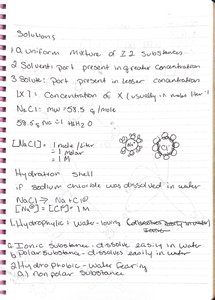
A solution is a uniform mixture of two or more substances. The solvent is present in greater concentration, while the solute is present in lesser concentration.
Hydration shell: Water molecules surround and dissolve ions or polar molecules.
Hydrophilic: Water-attracting substances.
Hydrophobic: Water-repelling substances.
Ionization of Water, Acids, and Bases
Ionization of Water
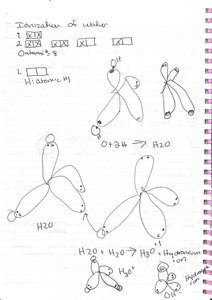
Water can dissociate into hydronium (H3O+) and hydroxide (OH-) ions. The concentration of these ions determines the pH of a solution.
pH:
Pure water: , pH = 7
Acids and Bases
An acid increases the hydrogen ion concentration in solution, while a base increases the hydroxide ion concentration.
Acid: HCl H+ + Cl-
Base: NaOH Na+ + OH-
The product of and in water is always at 25°C.
Organic Chemistry: Carbon Compounds
Hydrocarbons and Carbon Chains
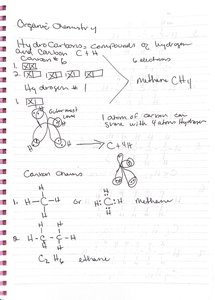
Organic chemistry focuses on compounds containing carbon. Hydrocarbons are composed only of hydrogen and carbon. Carbon atoms can form chains and rings, allowing for a diversity of organic molecules.
Methane (CH4): Simplest hydrocarbon, tetrahedral geometry.
Ethane (C2H6): Two carbon atoms bonded together.
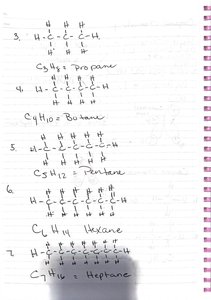
Propane, Butane, Pentane, Hexane, Heptane: Increasing chain length, each with unique properties.
Structural Formulas of Alkanes
Alkanes are saturated hydrocarbons with single bonds between carbon atoms. Their general formula is CnH2n+2.
Propane: C3H8
Butane: C4H10
Pentane: C5H12
Hexane: C6H14
Heptane: C7H16
Additional info:
Some explanations and definitions were expanded for clarity and completeness.
Tables and diagrams were described and included where directly relevant to the text.
