 Back
BackBacteria and Archaea: Structure, Function, Diversity, and Impact
Study Guide - Smart Notes
 Tailored notes based on your materials, expanded with key definitions, examples, and context.
CH.27: Bacteria and Archaea
Overview of Prokaryotes
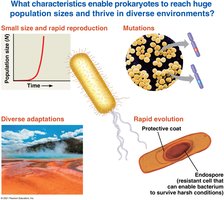
Prokaryotes, comprising the domains Bacteria and Archaea, are single-celled organisms that thrive in diverse and extreme environments. They are the most abundant organisms on Earth, capable of reaching huge population sizes due to their unique structural and functional adaptations.
Adaptation: Prokaryotes are found in environments ranging from hot springs to deep-sea vents.
Abundance: Their rapid reproduction and mutation rates contribute to their evolutionary success.
Structural and Functional Adaptations
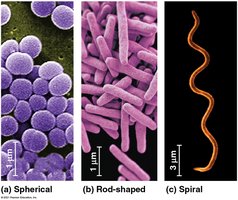
Prokaryotes were the first organisms to inhabit Earth. Most are unicellular, though some form colonies. Their cells are typically 0.5–5 µm, much smaller than eukaryotic cells (10–100 µm), and exhibit a variety of shapes:
Cocci: Spherical
Bacilli: Rod-shaped
Spirals: Spiral-shaped
Cell Wall Composition
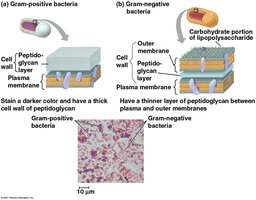
Bacterial cell walls: Contain peptidoglycan, a network of sugar polymers cross-linked by polypeptides.
Archaeal cell walls: Composed of polysaccharides and proteins, lacking peptidoglycan.
Eukaryotic cell walls: Made of cellulose or chitin.
Gram stain: Used to classify bacteria by cell wall composition.
Gram-positive bacteria: Thick peptidoglycan layer, simpler walls.
Gram-negative bacteria: Thin peptidoglycan layer, complex walls with an outer membrane containing lipopolysaccharides.
Capsules and Slime Layers
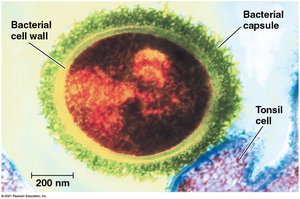
Many prokaryotes have a sticky layer of polysaccharide or protein surrounding the cell wall, called a capsule (dense and well-defined) or slime layer (not well organized). These structures:
Enable adherence to substrates or other cells
Prevent dehydration
Protect against the host’s immune system
Endospores
Some bacteria form metabolically inactive endospores when water or nutrients are lacking. The cell copies its chromosome and surrounds it with a multilayered structure, allowing survival in extreme conditions for centuries. 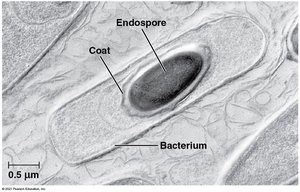
Fimbriae and Pili
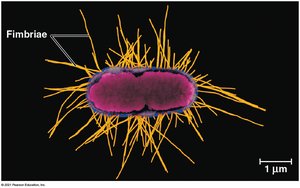
Fimbriae: Hairlike appendages for adherence to substrates or other cells.
Pili (sex pili): Longer appendages used to pull cells together for DNA exchange.
Motility and Flagella
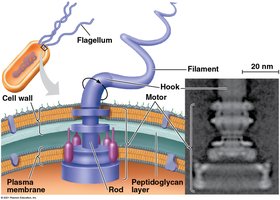
About half of prokaryotes exhibit taxis, moving toward or away from stimuli (e.g., chemotaxis). Flagella are the most common structures for movement, either scattered or concentrated at cell ends.
Bacterial flagella: Composed of motor, hook, and filament; evolved through exaptation.
Internal Organization and DNA
Prokaryotic cells lack complex compartmentalization but may have specialized membranes for metabolic functions (e.g., infoldings of the cell membrane). 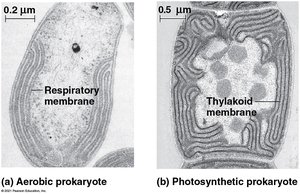
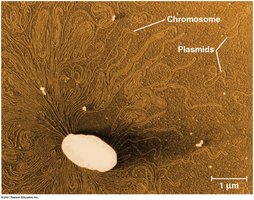
DNA: One circular chromosome located in the nucleoid (no membrane).
Plasmids: Small rings of independently replicating DNA.
Genetic Diversity in Prokaryotes
Rapid Reproduction, Mutation, and Genetic Recombination
Three factors contribute to high genetic diversity:
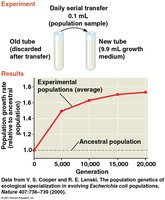
Rapid reproduction: Binary fission allows division every 1–3 hours under optimal conditions.
Mutation: Low rates, but accumulate rapidly due to short generation times and large populations.
Genetic recombination: Combining DNA from two sources via transformation, transduction, or conjugation.
Transformation
Prokaryotic cells incorporate foreign DNA from their surroundings, potentially acquiring new traits (e.g., pathogenicity).
Transduction
Bacteriophages (viruses that infect bacteria) transfer prokaryotic genes from one host cell to another, usually as an unintended result of the phage replicative cycle. 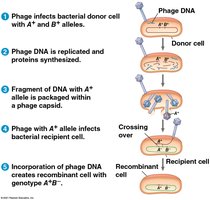
Conjugation and Plasmids
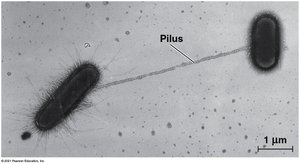
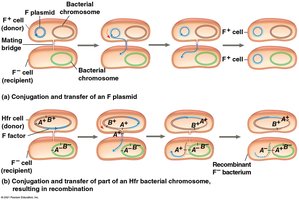
Conjugation: DNA transfer between two prokaryotic cells, typically one-way.
Pilus: Attaches donor to recipient, retracts to bring cells together, DNA transferred via "mating bridge".
F factor: Required for pilus production, can exist as plasmid or chromosomal segment.
R Plasmids and Antibiotic Resistance
R plasmids: Carry resistance genes, often for multiple antibiotics.
Enable rapid spread of resistance via horizontal gene transfer.
Diversity of Nutritional and Metabolic Adaptations
Energy and Carbon Sources
Prokaryotes are classified by how they obtain energy and carbon:
Phototrophs: Energy from light
Chemotrophs: Energy from chemicals
Autotrophs: Carbon from CO2 or related compounds
Heterotrophs: Carbon from organic nutrients
Role of Oxygen in Metabolism
Obligate aerobes: Require O2 for cellular respiration
Obligate anaerobes: Poisoned by O2, use fermentation or anaerobic respiration
Facultative anaerobes: Can use O2 or carry out fermentation/anaerobic respiration
Nitrogen Metabolism
Nitrogen fixation: Conversion of atmospheric N2 to ammonia (NH3)
Essential for amino acid and nucleic acid production
Metabolic Cooperation
Prokaryote cells may cooperate to use resources unavailable to individual cells. In Anabaena, cells specialize for nitrogen fixation (heterocysts) or photosynthesis, exchanging nutrients. 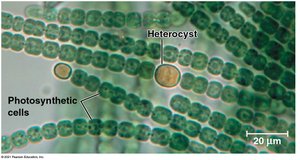
Biofilms
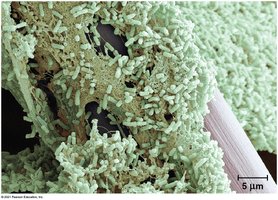
Cells of one or more prokaryote species cooperate to form surface-coating colonies called biofilms.
Cells secrete sticky proteins and polysaccharides
Channels allow nutrient and waste transport
Biofilms cause corrosion, contamination, tooth decay, and chronic infections
Diversity and Evolution of Prokaryotes
Lineages and Phylogeny
Prokaryotes date back 3.5 billion years and inhabit every environment supporting life. Genetic analysis divides prokaryotes into Bacteria and Archaea. Horizontal gene transfer has played a key role in their evolution, resulting in mosaic genomes. 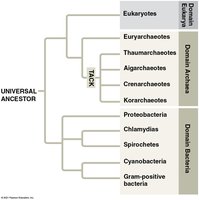
Major Groups of Bacteria
Proteobacteria: Gram-negative, includes photoautotrophs, chemoautotrophs, heterotrophs, and pathogens.
Chlamydias: Parasitize animal cells, gram-negative, lack peptidoglycan.
Spirochetes: Helical, gram-negative, free-living or pathogenic.
Cyanobacteria: Gram-negative photoautotrophs, likely ancestors of plant chloroplasts.
Gram-positive bacteria: Diverse, includes pathogens and soil decomposers.
Archaea
Archaea share traits with both bacteria and eukaryotes.
Extremophiles: Live in extreme environments (halophiles, thermophiles).
Methanogens: Obligate anaerobes producing methane.
TACK supergroup: Includes Thaumarchaeota, Aigarchaeota, Crenarchaeota, Korarchaeota.
Lokiarchaeotes: Closely related to eukaryotes, may shed light on eukaryotic origins.
Prokaryotes in the Biosphere
Ecological Roles
Prokaryotes are essential for recycling chemical elements between living and nonliving components.
Decomposers: Break down dead organisms and wastes, releasing carbon and other elements.
Autotrophs: Produce sugars and O2 consumed by other organisms.
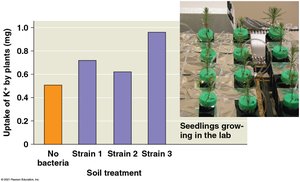
Nitrogen-fixers: Transform atmospheric nitrogen into usable forms.
Ecological Interactions
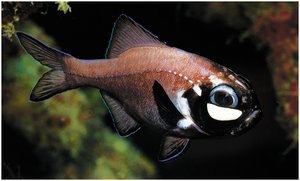
Symbiosis: Close relationship between two species (mutualism, commensalism, parasitism).
Mutualism: Both organisms benefit.
Commensalism: One benefits, other unaffected.
Parasitism: Parasite harms host, often causing disease (pathogens).
Prokaryotes and Humans
Beneficial and Harmful Impacts
Mutualistic bacteria: Human intestines host 500–1,000 species, aiding digestion and nutrient synthesis.
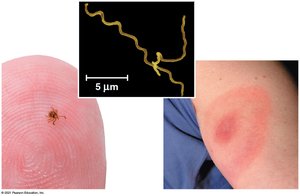
Pathogenic bacteria: Cause about half of all human diseases (e.g., tuberculosis, Lyme disease).
Exotoxins: Proteins secreted by bacteria causing disease even if bacteria are absent.
Endotoxins: Lipopolysaccharide components released when bacteria die.
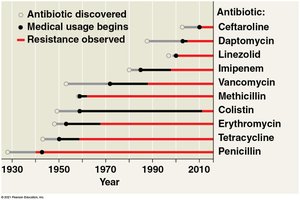
Antibiotic resistance: Rapid evolution and horizontal gene transfer spread resistance genes.
Prokaryotes in Research and Technology
Food production: Cheese, yogurt, beer, wine, fermented foods.
DNA technology: E. coli used in gene cloning; DNA polymerase from Pyrococcus furiosus used in PCR.
CRISPR-Cas9: Gene editing tool derived from prokaryotic defense systems.
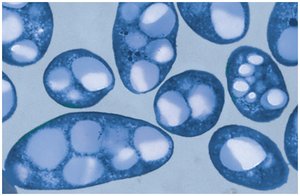
Bioplastics: Bacteria synthesize PHA, used for biodegradable plastics.
Biofuel production: Engineering bacteria to produce ethanol from agricultural waste.
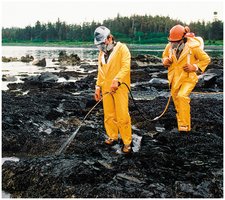
Bioremediation: Use of bacteria to remove pollutants (e.g., oil spills).
Summary Table: Comparison of the Three Domains of Life
Characteristic | Bacteria | Archaea | Eukarya |
|---|---|---|---|
Nuclear envelope | Absent | Absent | Present |
Membrane-enclosed organelles | Absent | Absent | Present |
Peptidoglycan in cell wall | Present | Absent | Absent |
Membrane lipids | Unbranched hydrocarbons | Some branched hydrocarbons | Unbranched hydrocarbons |
RNA polymerase | One kind | Several kinds | Several kinds |
Initiator amino acid for protein synthesis | Formyl-methionine | Methionine | Methionine |
Additional info: This table summarizes key differences among the three domains, highlighting structural and molecular distinctions.
